遠々洛外
  • 遠々洛外のブログ - Far Beyond the Miyako Blog

The justification of katakiuchi

29/9/2014

 
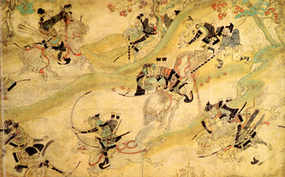
PictureAkuto and musha-gari Source: http://1000ya.isis.ne.jp
Recognised as a social norm

On a certain morning in the eighth month of the 24th year of Ōei (1417), in a space beside the entrance to a private house between the Kyoto avenues of Ayano Kōji Ōmiya and Shijō Ōmiya, an incident occurred whereby a priest of the Hokke sect was assassinated by two individuals.  The assassinated priest had been chased along Ōmiya road and had made his way north, finally seeking refuge in a private house.  His assailants had made their way into that house, and there they had assassinated the priest.  There was, however, no way that the people of the surrounding township would silently allow someone`s private home to be violated and a murder take place.  They immediately flew out of their houses and apprehended the assailants.  They then made their way to the samurai-dokoro of the Bakufu, and there presented the two culprits. (p.37)

As became clear during the subsequent investigation, the murderer was the leader of the two, who in the guise of a priest had killed the Hokke priest with a `great sword` (or daitō). The other member had apparently placed a bow and its case (or utsubo, 靫) in the vicinity of the crime.  According to the testimony of the accused, the murdered priest had been a `katakiuchi`. What is particularly interesting about this case is that the person who recorded it their diary, Nakahara Yasutomi, was a highly regarded official who wrote down his impression of the case.  In Nakahara`s view, it was an example of “the mysteries of divine will”.  In other words, upon hearing that the murdered priest had been a `katakiuchi`, Nakahara chose to praise the murderers.  So how about that.  Nakahara did not consider what the two individuals had done as a bad thing, but appears to have thought that they should be thanked for their deed. (p.37)

In order to prove that this was not a peculiar characteristic of Nakahara`s way of thinking, Nakahara continued with the following  “ただし、かくのごとき仮りごと、つねにあるのあいだ、信ずるにおよばず” (However, this is a commonly repeated lie (that the murdered person was a katakiuchi), and so it cannot simply be believed). In other words, whether or not this was an example of katakiuchi was beside the point. The murdered priest clearly wasn`t a true katakiuchi, and there were many examples of people murdering others and then claiming the other party was a katakiuchi in order to escape punishment. (p.37-38)

For example, in the 4th year of Eikyo (1432) on the estate of Nishi Kawai in the province of Harima (now part of Kasai City in Hyogo prefecture), two samurai by the name of Nakamura Sado Nyūdō and Kōzuki Yamato no Kuni killed another local samurai named Kōhana Hikozaemon Nyūdō and appropriated his tribute. At least, this was the charge that the Bakufu made against the owner of the estate, the shrine of Iwashimizu Hachimangū.  Iwashimizu then attempted to come up with a variety of counter arguments to justify the killing.  They claimed that Kōhana had been their own retainer in the service of a local official, and part of the younger band of retainers, while also being a `katakiuchi`.  In the end Iwashimizu lost the case. They had been prepared to claim that Kōhana was a katakiuchi despite the fact that it wasn`t true.  Given this state of affairs, it is fairly clear that for the society at the time, to kill a katakiuchi was not itself regarded as illegal.  (p.38-39)

By using these social mores, each party attempted to justify murder.  As Nakahara had written, it was fairly common to see people who claimed that they had killed a `katakiuchi` in order to justify the killing. When one considers that they were brazen enough to use this defence in the Bakufu`s own law courts, then there is a very high probability that killing a katakiuchi was regarded by society as normal. In the second month of the 2nd year of Kenan (1362), a legal official for the Muromachi Bakufu, when asked to give an opinion on the criminality of katakiuchi,  wrote about a precedent in the `Goseibai Shikimoku` (御成敗式目) as ratified by the Kamakura Bakufu.  According to this document, if the offspring of an individual kill their father`s enemy, they will be found innocent. Yet if one digs a little deeper, one finds that in the original Goseibai Shikimoku, there is no such clause.  Rather, Article 10 of the original document states the exact opposite. (p.39)

If the offspring of an individual should kill their father`s enemy, both the father and his offspring shall be punished. This error in interpretation can either be attributed to a simple mistake on the part of the legal official, or else it might have been a deliberate attempt by the official to change the meaning of Article 10.  In truth, it is difficult to decide either way.  Nevertheless, while the practice of katakiuchi may have been banned within the original Goseibai Shikimoku, by the Muromachi era even officers of the law had diverted from the original interpretation (or else ignored it) and thus there began to appear people attempting to justify katakiuchi. (p.39)
The insidious nature of the people of the Muromachi period - Part Two

21/9/2014

 
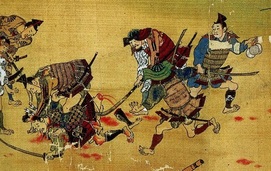
PictureSource: kjclub.com
The legitimacy of `Shin Katakiuchi`

Was killing an enemy `officially sanctioned`?

Research dealing with revenge and `killing one`s enemies` has a long history in this country, at least from the Meiji period onwards.  Although it is complicated, this is an important problem area, hence an explanation of a bit of the history of this research is in order. 

The first direct commentary on the phenomenon of `killing one`s enemy` was made by Nitobe Inazō (1862-1933), the author whose visage appeared on the old five thousand yen note.  In the middle of his literary work `Bushidō`, which was the first to convey to the outside world the Japanese concept of beauty (English version 1899, Japanese translation 1908), Nitobe touched upon `killing one`s enemy`, or katakiuchi, 敵討.  Nitobe wrote that the pre-Early Modern samurai use of `katakiuchi` was a means to preserve the mores of society in a `world without law courts`, and so it functioned as a `logically equitable system of justice`.  Nitobe thereby placed the samurai social practice of `katakiuchi` amid the universal history of mankind.(34-35)

The next person to deal with this issue from a legal perspective was the so-called `giant` of the Meiji and Taishō legal world, Hozumi Nobushige (1855-1926). In his work `Revenge and the Law` (Fukushū to Hōritsu, published posthumously in 1931), Hozumi took the view that the transcendence of revenge killings by the law was an important development in the history of mankind, and so established `katakiuchi` as a product of an era in which revenge was officially sanctioned. According to Hozumi, the history of mankind evolved from `an era in which revenge was sanctioned` to `an era in which revenge was limited`, and finally to `an era in which revenge was banned`. (35)

This study was followed by that of Hiraizumi Kiyoshi (1895-1984), the author of `The Imperial View of History` (Kōkoku Shikan) which promoted an ultra nationalistic view of history during the Pacific War.  In his work `Social temples and society in the medieval period` (published in 1926), Hiraizumi examined the question of sanctuary and revenge in medieval Japan.  While declaring that the social temples of medieval Japan performed a role similar to that of monastic sanctuaries in Western Europe, he also pointed out that the existence of revenge killings in medieval Japan led to the development of the concept of sanctuary.  It was Hiraizumi who also posited that the gradual elimination of revenge killings by the courts in turn led to the elimination of sanctuary from society.  For Hiraizumi, sanctuary existed in tandem with katakiuchi .(35)

These three theories may be termed `the traditional academic definition` of katakiuchi, and as is clear from a reading of all three, Nitobe developed his in order to promote recognition among Western society of the Japanese concept of beauty, while Hozumi and Hiraizumi both created their theories using the context of the nineteenth century theory of evolution and how this led to the development of the law (as well as the development of Japanese history).  All three writers formed their views from the historical material available to them at the time, and the abundance of collateral evidence is truly astounding.  Yet the danger in their theories lies in their excessive praise of the conquest of revenge by the state. This probably stems from the age in which all three writers lived, yet one cannot help feeling that they attempted to simplify and pre-establish a linear pattern for what is a complicated historical development.  (36)

In conclusion, this means that as far as their historical research was concerned, the development of a unique law such as `mutual punishment` (Kenka Ryōseibai) was deliberate. All three writers` theories were in keeping with the age in which they lived.  They saw the law leading society out of the dark ages into a brighter age of social mores.  At the time the writers lived in, the practice of mutual punishment was regarded as the force that changed society, despite a lack of evidence to collaborate this. The theory was then simply inserted into the framework of the theory of evolution, thus giving it an overly positive reputation. The dangers of forming such a glorified theory on the creation of order by the state can be seen in the way that Hiraizumi advocated the `Imperial View of History` and leaned towards ultra nationalism. (36)

In response to this `traditional academic definition`, the criticisms of postwar Japanese legal history turned towards the basic facts that all three writers insisted upon, that is, that the practice of `katakiuchi` in Japanese history was `officially sanctioned` as a `logically equitable system of justice`.  Ishii Ryōsuke, who built the foundations of postwar Japanese legal history, stated that the within the annals of Japanese history, the first appearance of `katakiuchi` as sanctioned by law was in the `Precepts of the Chōsokabe Family`, a document drawn up in Keichō 2 (1597) by the Chōsokabe of Tosa province (modern Kōchi prefecture), and therefore of the Edo period. In no way was katakiuchi `officially sanctioned` in general before this time, and thus the legal theory of evolution as promulgated by the traditional academic definition did not fit the Japanese model. (37)

In truth, the existence of katakiuchi as a legally sanctioned form of authority and its incorporation into the exercise of public authority, as in the `trials by combat` of medieval Europe, is almost impossible to confirm before the early modern period in Japan. Moreover, while katakiuchi might have been a statutory law during the medieval period, one is forced to conclude that before the early modern period, katakiuchi was banned in all but statutory law. For this reason, for a long time after the war researchers believed that katakiuchi of the medieval period was an illegal activity, and thus there wasn`t much interest in examining the phenomenon in detail. (37)

However research after this period led to a rejection of this point of view, and at present the view is that katakiuchi was not necessarily an illegal act.  The author has found a number of examples from the Muromachi period to illustrate this point, which shall be examined in detail next week. (37)


The insidious nature of the people of the Muromachi period

14/9/2014

 
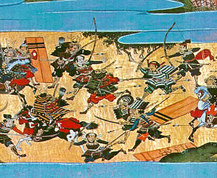
PictureSource: rekishi.maboroshi.biz
This post takes as its theme a short excerpt from the book “Kenka Ryōseibai no Tanjō” (or The Birth of the Practice of Mutual Punishment) by Shimizu Katsuyuki.  It is a tremendous read on how the concept of punishing both sides involved in a dispute came to be so widely used throughout Japan during the Muromachi period. The excerpt below starts just after chapter one, hence there is a bit of a disconnect between it and the first paragraph of chapter two, but bear with it, as it does contain some interesting information.  I will translate more of the chapter as time permits, as this is an area that I would very much like to examine further.

Not even daimyō could do as they wished

This does not mean that the people of the Muromachi period flew off the handle at the drop of a hat or went around in a permanent state of agitation.  Although we might readily use the word “fight” (or ‘kenka’, 喧嘩), when one closely examines the historical records, this concept was divided into different categories  such as a “tōza no kenka” (or ‘random fighting’) and “shukui no kenka” (or ‘feuds’). Fighting that occurred at the time could either be a sudden, random event, or it might have been an act of revenge stemming from long held grudges. As we saw in the examples from the previous chapter, while trouble often arose from drunken arguments, the people at the time maintained a strong sense of personal pride, and unless alcohol was involved or some other special circumstance, were not easily provoked to anger. 

That is to say, for the society at the time ‘feuds’ were a much more serious problem that ‘random fighting’.  It is for this reason that this chapter shall examine the former, and consider acts of revenge and ‘slaying one’s opponent’ (or ‘katakiuchi’, 敵討ち). The Jesuit missionary Valignano, who journeyed to Japan in the sixteenth century, wrote about the extraordinary calculating nature of the Japanese in his ‘Record of Travels throughout Japan’ in the following manner;

They (the Japanese) show a great deal of restraint, and do not openly express what they are thinking.  As they keep such a hold over their anger, when they do express anger it is slight (abridged) Even though they might be the worst of enemies, both sides maintain the cheeriest of expressions, and do not for a moment consider abandoning the etiquette that they are used to.  They harbour the most conspiratorial of thoughts deep within their hearts and yet have the most refined and respectful countenance, all the while biding their time, gritting their teeth  and waiting for their day of victory to arrive. (pp.30-31)

Japanese people at the time had a very strong sense of honour, yet at the same time this was combined with an insidious nature whereby they `harbour the most conspiratorial of thoughts deep within their hearts` while `biding their time, gritting their teeth and waiting for the day of victory to arrive`. For the daimyō of the Muromachi era in particular, who hired retainers who would not hesitate to `kill their master`, they had to live day to day in fear of their retainers ` treachery. When one reads the historical records, they often discuss the outbreak of hostility between the Muromachi Shōgunate of this period and daimyō. As there are so many examples of such behaviour, while some might argue that this was a genealogical pattern of a system centred on the Ashikaga family, I prefer to think that this behaviour was caused by the power structure of the time and the mentality of retainers. (p.31)

It was particularly difficult at the time for the head of a household, such as a daimyō, to have his wishes concerning successors or administration of the household enforced at will, as the opinions and ideas of retainers also had to be respected. As we learned from the previous chapter, these retainers placed more importance on their own honour that following the precepts of their lord. If the head of the household had been able to exercise complete control over the household and have a clear, fixed position at the centre of the household, as was the case with daimyō of the Early Modern period, then this would not have been a problem.  Yet the household politics of this era was distinguished by the `power balance` between the daimyō and his retainers, and the fluctuation of events between them. (p.31) It was a result of this precarious state of affairs that daimyō were not able to control their retainers at will, and so I think there were probably quite a few daimyō whose sanity might have slipped as a result of living in the midst of such anxiety. (p.31)

In reality, daimyō such as Hosokawa Katsumoto and Yamana Sōzen, who controlled rival sides during the Ōnin and Bunmei wars, did not anticipate that their feud would spark such a major conflict, and that the conflict itself would drag on for six years, driving Katsumoto to take the tonsure, almost forcing Sōzen to commit ritual suicide, and hastening the early deaths of both men. While both men may have been powerful daimyō, they were unable to control their own factions or the retainers who served under them, and so may have been driven to death by the strain this had on them.  The actions of generals of the Muromachi period, when compared to that of the Era of the Warring States, were feeble and at times incomprehensible, yet they had their origins in the power structure that these generals supported and the expectations of society at the time. (p.32)

Strike or be struck?

Yet while living in this era, daimyō also `harbour(ed)  the most conspiratorial of thoughts deep within their hearts` while `biding their time, gritting their teeth and waiting for the day of victory to arrive`, and had a vindictiveness equal to any of their peers.  Daimyō would seek to cut off any budding revolt by their retainers before it had a chance to grow, and planned for just such an eventuality. It was just such behaviour that the missionary Organtino witnessed during his stay in Japan during the sixteenth century, an experience he wrote about in the following manner;

They (the Japanese) do not punish people with the whip, yet if a lord and master can no longer stand the malicious behaviour of their retainer, they bring that retainer before them, and with no show of anger or indignation, have that retainer put to death.  As for why they do this, if the lord exhibits any show of dislike or doubt towards a retainer, the lord will be killed first. (p.32)

When killing a retainer, a daimyō would show `neither anger nor indignation` and would have the act done as quickly as possible.  If they didn`t, then they might be done in.  It is quite horrible to contemplate, but it was common practice in the Muromachi period.  There are many examples of daimyō, without showing any outward sign of anger, suddenly killing (or attempting to kill) a retainer.

In the sixth month of the 2nd year of Hōtoku (1450), in the town of Furuichi in the province of Yamato (modern Nara Prefecture), there was a samurai by the name of Udaka Arimitsu who, with his family in tow, asked to serve in the household of the kokujin Furuichi family.  It was at this time that Anmiji Kyōgaku, who was under pressure exerted by the same Furuichi family, wrote in his diary that this Udaka fellow was formerly a retainer in Kyoto to the shugo of Izumi province, Hosokawa Tsuneari. As a result of Udaka`s `disobeying the orders of his master` (shumei ni somuku, 主命に背く)  and `trouble with his colleagues` (Hōbai no sata, 傍輩の沙汰), Hosokawa Tsuneari arranged for an attack to be made on Udaka`s lodgings at night, and with his own hand attempted to cut Udaka down.  This act by Tsuneari was in exactly the same manner as that described by Organtino in his writing. However the night attack ended in failure, with Udaka fleeing from Kyoto and making his way to seek sanctuary with the Furuichi.  (p.33)

Fortunately for Udaka the Furuichi were in a welcoming mood, and after being invited to view the famous `wind dance` performed by the Furuichi family, Udaka spent a few months in good company. It seems he also became quite friendly with Kyōgaku as well, the author of the diary.  Yet in the ninth month of the same year, Kyōgaku began to hear some very puzzling rumours.  It seems that Udaka had been going around saying that the former Kanrei Hosokawa Katsumoto wanted him back in the capital, and so he was planning on returning to Kyoto within a few days.  For a person whose life had been threatened by the Izumi Hosokawa family, and who had not actually been pardoned, the fact that he was now being invited back to the Hosokawa household after such a short space of time was, strangely enough, an opportunity not to be missed.  Indeed, he was positively entranced by it. (p.33)

After hearing this rumour, Kyōgaku could not help thinking`this is all too sudden, there must be something behind it` . Yet whether Kyōgaku never expressed his concerns to Udaka, or whether Udaka chose to ignore Kyōgaku`s warnings, we will never know.  On the following day, Udaka, together with his family, left the company of the Furuichi and made his way slowly back to Kyoto. (p.35)

News that Kyōgaku`s suspicions had been confirmed arrived just six days later.  Udaka had been ambushed upon his return to Kyoto, and `that he, along with sixteen, or seventeen members of his family and younger retainers` had all been killed.  Although Kyōgaku might have written `it is as I suspected` (anzuru ga gotoshi, 案ずるがごとし), that didn`t really make a difference. The invitation had been too attractive to be missed. (p.35)

It appears that the Izumi Hosokawa and Hosokawa Katsumoto had been involved together in the plot.  Katsumoto had learned not to waste his experience of nearly being assassinated by his retainers, and had learned to tame his harsh words towards those who might seek to divide the household. Instead he would use their ambitions against them, and by doing so extinguish all opposition.  So, just as the missionary quoted before said, Katsumoto was successful in his insidious form of revenge, and tore out the buds of rebellion (p.35).   


Resolving disputes when no other options are available - the Honnin Seppuku Sei

4/10/2013

 
PictureSource: blog.livedoor.jp Ashigaru
This post follows on from that made last week, in that it continues with another chapter taken from Shimizu Katsuyuki’s 「喧嘩両成敗の誕生」, specifically that which deals with an attempt by the Muromachi Bakufu to change the mores of the mid-medieval period away from reliance on ‘Jiriki Kyūsai’ (自力救済, or ‘self-preservation’) to enforcement of central authority in disputes between rival retainers of various households. (156) The legislation that the Muromachi Bakufu adopted in order to do this was known as 「本人切腹制」”Honnin Seppuku Sei”, or “System for the Ritual Suicide of the Person (s) Concerned”. In his introduction to the chapter, Shimizu relates a specific example of this system at work. (156)

In the sixth month of Bunmei 11 (1479), there occurred an incident out the front of Kitano Shrine in Kyoto. A retainer of Isshiki Yoshinao by the name of Nariyoshi, with a number of accomplices, attempted to steal bamboo roots that were growing amid the piles of wood out the front of the shrine. The attendants of Kitano Shrine (known as Miyaji, or 宮仕, themselves a lower class of attendant), upon catching Nariyoshi’s mob in the act, tried to stop them from making off with their loot. Nariyoshi and his group did not take kindly to this, and so a fight broke out among the two groups. It appears as though Nariyoshi’s group had the advantage in numbers, for three Miyaji from Kitano Shrine were killed with no apparent losses to Nariyoshi. Other Miyaji from Kitano Shrine that witnessed the violence were so incensed by Nariyoshi’s act and the senseless deaths of their colleagues that they resolved to shut themselves up in the inner sanctum of the shrine. They then used the divine authority vested on the shrine as a shield to send a message of protest to the Bakufu, demanding that Nariyoshi and his group be dealt with promptly. (156-157)

The Muromachi Shōgun at the time, Ashikaga Yoshihisa, was unusual in that he took a particular interest in administrative and legal matters and so moved rapidly to deal with the culprits. Yoshihisa handed down a missive to the Nariyoshi’s master, Isshiki Yoshinao, ordering him to punish Nariyoshi and the others based on ‘their equivalent crime’ (相当の罪). As a consequence, Nariyoshi was forced to order one of his followers to commit ritual suicide, given that this person was the instigator or ‘person concerned’ of both the theft of the bamboo roots and the violence that followed. Nariyoshi himself later fled the capital. (157)

In the medieval period, the term 「相当」(Sōtō) meant  ‘damage or loss to the same degree or extent’. Since three Miyaji of Kitano Shrine had been killed during the incident, the punishment to be metered out based on ‘equivalent crime’ meant that three members of Nariyoshi’s retinue would also have to die. However in this instance, the only person forced to commit ritual suicide was the one who had sparked the violence out the front of Kitano Shrine. On this basis, one could not say that is was ‘punishment based on an equivalent crime’.  Yet this measure appears to have satiated the desire for revenge by the Miyaji of Kitano Shrine, who then came out from the inner sanctum, thereby bringing the entire incident to a peaceful conclusion. From the point of view of traditional medieval social logic, which demanded punishment of an equal kind in retaliation, this conclusion was completely nonsensical. Yet it was indicative of the system used by the Muromachi Bakufu, that of the Honnin Seppuku Sei. (157)

There were three particular characteristics of this system at work which explain why it was implemented. The first, and most important, was the fact that no matter how many victims there were, the ‘instigator’ directly responsible for causing the incident would be the only one punished. The second was that the punishment metered out against the ‘instigator’ would not be carried out on a direct order from the Bakufu. Instead the Shōgun would send an order to the lord or master of the ‘instigator’, demanding that he deal with his retainer. The third was the fact that in the end, the instigator would accept the order from his master and commit ritual suicide (or jigai, 自害). (157)

These were the characteristics of the system. It’s now worthwhile exploring each in turn. First, let’s take a look at the second characteristic, the more ‘roundabout’ system of punishment whereby the Shōgun would not pass sentence against the ‘instigator’ directly but instead would order the master of that ‘instigator’ to carry out the punishment. As was outlined in Chapter Two, the area within the private residence of shugo daimyō during the Muromachi period possessed a strong degree of independence, to the extent that the Shōgun himself could not enter it the residence without prior permission from the owner concerned. This exactly mirrored the system of control that the shugo daimyō themselves exercised against their retainers. (158)

From a logical point of view, as the Shōgun was the master over the shugo daimyo and they were his vassals, and as the retainers of the shugo daimyō were vassals of those daimyō, then the Shōgun should have been able to exercise direct control over the retainers of the shugo daimyō as well. Yet in principle this was not permitted. In the 5th month of the 23rd year of Ōei (1416), a retainer of Hatakeyama Michiie and another of Uramatsu (Hino) Yoshisuke became involved in a fight while returning from the Kamo Kurabeuma ( 加茂競馬, a religious event held at Kamigamo Shrine in May), which resulted in bloodshed. The Shōgun at the time, Ashikaga Yoshimochi, thereafter reprimanded (突鼻, totsupi) the masters of these retainers, Hatakeyama and Uramatsu, but did no more than this. (158)

In medieval Europe, “the retainer of a retainer is not your vassal” was an often said phase, yet the same could also be said of medieval Japanese society. Although the master of a criminal might be his own vassal, in principle the Shōgun did not have the power to transcend his vassal’s authority in order to punish the criminal. Under the mores of the day, what the Shōgun could do was to order his vassal to punish the transgressor, yet there was no direct way through which the Shōgun could question the authority of his vassal or punish his vassal.(158) It was the same no matter what level of society it occurred at.(158)

In order to punish the ringleader of the violence at Kitano Shrine, Yoshihisa first issued an order to Nariyoshi’s master Isshiki Yoshinao demanding that he punish the perpetrator. Isshiki then issued his own order, demanding that Nariyoshi punish the guilty party. The circuitous administration of the Honnin Seppuku Sei  was entirely in keeping with the master-retainer system that existed at the time. Such administration was an unavoidable fact of life at the time, and may in fact have been encouraged. A particularly asute and intelligent aristocrat of the mid-to-late Muromachi period, Ichijō Kaneyoshi, in his collection of political essays dedicated to Shōgun Ashikaga Yoshihisa known as the Shō Danchō (樵談治要), paid particular attention to the growing menace of “ashigaru” (or foot soldiers, 足軽) that began to appear on the streets of the capital following the Ōnin and Bunmei periods (late fifteenth century). Kaneyoshi called the ashigaru “extreme villains” and launched into damning criticism of them in his writing.(159)

Kaneyoshi’s writing is a particularly valuable historical resource given its recount of the activities of these ashigaru and how these contrasted to the prejudiced views of the aristocracy.  As such, it is often quoted in historical studies although the writing itself is not very well known. I offer the advice Kaneyoshi put forward to getting rid of the ashigaru as an example of his work. (159)

“No matter who the ashigaru happens to be, every ashigaru has a master. If such things happen again from here on, the masters of each of the ashigaru should be made to take responsibility and punish their ashigaru. If a system existed whereby an ashigaru, if he happened to be either a peasant or a merchant, would be subjected to punishment after an order was sent to his ‘place of residence’ (either a village or town), ashigaru as a profession would cease to exist.” (159)


The sensitivities of Kyoto-ites, or how not to handle an insult

27/9/2013

 
PictureSource: jimmyblanca.blogspot.com
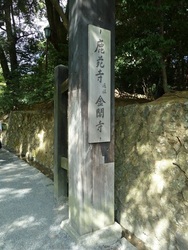
This particular post takes as its inspiration the first chapter from the book ‘Kenka Ryōseibai no Tanjō’ (the Birth of ‘Mutual Punishment’ 喧嘩両成敗の誕生) by Shimizu Katsuyuki (清水克行), a relatively young scholar at Meiji Gakuin University. The book itself, as the title outlines quite clearly, is concerned with tracing the origins of the phenomenon of ‘Kenka Ryōseibai’ as it existed from the Kamakura through to the Muromachi period. The first chapter of the book sets the scene for quite vividly, as it relays an event that occurred in the 5th month of Eiryō 4 (or 1432) in the vicinity of Rokuonji temple, more commonly known as Kinkakuji (金閣寺, or ‘the Temple of the Golden Pavilion’).

Kyoto society during the medieval period periodically witnessed acts of violence committed by the members (or followers) of various temples and shrines. Some of the most pugilistic belonged to Rokuonji temple and Kitano Tenmangū (or Kitano-sha), and it was just such a clash between the followers of both institutions that brought Kitano-sha within a hair’s breadth of being attacked by a much larger group from Rokuonji. Fortunately for posterity (and those inside Kitano-sha at the time), Muromachi Shōgun Ashikaga Yoshinori received news of the impending attack and sent troops of his own to prevent it from happening thereby keeping any damage to a minimum. Strangely enough, it was the most innocuous of incidents that led in turn to the Shōgun having to call out the troops, and concerned a perceived insult against Rokuonji by two members of the Kitano-sha. (12)

The incident itself began when seven or eight priests belonging to Kitano-sha decided to pay a visit to Rokuonji in order to do a bit of sightseeing. The priests themselves had travelled from the provinces to the capital in order to participate in the ‘Kanjin Kusemai’ (勧進くせ舞, or a temporary ritual performed in order to raise funds for the construction of new temple buildings), and were making their way back home when they decided to call in to Rokuonji, which none of them had seen before. Two young servants that were accompanying the priests had already gotten drunk on alcohol before venturing to the gates outside Rokuonji, and were quite intoxicated. It was at precisely this time that a priest of Rokuonji, not exactly acting in keeping with his profession, was standing in front of the entrance gates to the temple complex relieving himself (aka, taking a quick leak). (12)

According to testimonies that were taken afterwards, one of the servants in the Kitano-sha priests’ retinue suddenly ‘laughed’ at the Rokuonji priest. In their deposition, Rokuonji claimed that the Kitano-sha priests and their servants had all said to the Rokuonji priest…’牛が罷り透る’ (hey, a cow is ‘passing by’). This, according to Rokuonji, was what sparked the incident. It may of course be possible that the Kitano-sha group slandered the Rokuonji priest by comparing him to a urinating cow, and while this wouldn’t really elicit a response today, it’s clear that as a result of some sort of provocation by the Kitano-sha group things soon got out of hand. (13)

If all that occurred was an exchange of drunken words then that would have preferable to what followed. However, given the times in which the incident occurred, there was no way that the Rokuonji priest could let the matter go. The priest then made a retort to the Kitano-sha group, of sufficient vitriol to cause the Kitano-sha group to become enraged. As the priest was outnumbered, he ran off with the Kitano-sha group in pursuit. Eventually the priest sought sanctuary within the grounds of Rokuonji temple, where despite their best efforts, the Kitano-sha group could not prise him out. Instead they then set about trying to break down the gates at the front of the temple in order to force their way in. (13)

Clearly this attempt to force their way into the temple was doomed to fail, however at that moment an old priest from Rokuonji made an appearance and attempted to placate the anger of the Kitano-sha group. Yet given the state of intoxication that the Kitano-sha group had fallen into, the priest’s words fell on deaf ears.  Moreover, some of the group had already drawn their swords and attempted to cut the old priest down where he stood. In this period it was quite common for priests to carry weapons on their person. As such, every so often what began as a verbal argument could escalate into murder. (14)

Realising that he didn’t have a chance against the drunken priests from Kitano-sha, the old priest ran back into the Rokuonji temple grounds and began to ring the temple bell to alert the surrounding area to the emergency that was now unfolding. Realising that something was wrong, those townspeople and priests who lived in the area in front of the temple quickly rushed to the scene. It was at that moment that the front of Rokuonji temple was transformed into a bloodbath. The priests from Kitano-sha became enveloped in an exchange of blows with the townspeople and priests of Rokuonji. According to one record, two of the priests from Kitano-sha were cut down, while one of the Rokuonji supporters was killed. According to a separate account, one of the Kitano-sha group was killed, one was wounded but ran off, while a third was captured.  No matter was the result was, the fact of the matter was that what had begun as a simple visit to Rokuonji had transformed into a dramatic battle to the death. (14)

However things did not end here. The followers of Rokuonji, enraged by the insults and outrageous behaviour of the priests from Kitano-sha, decided that they would take their revenge on Kitano-sha itself. It was just at the moment when the two sides were preparing to engage in all-out warfare that the situation changed dramatically.  Having gotten word of the crisis, Ashikaga Yoshinori issued orders to his officials Inō Tametane and Matsuda Ushihide, telling them to clamp down on the Rokuonji followers. It was this intervention by the Shōgun that brought the matter to a close. (14)

Nowadays Rokuonji is a major tourist attraction, annually visited by around 5 million people. Yet there are probably none among the many visitors who realise that a fight to the death took place just outside the front gates of the temple complex. Yet the fact that such a vicious, and ultimately meaningless conflict could occur just outside the gates of Rokuonji, itself a symbol of the authority of the Muromachi Bakufu, is indicative of the age in which such events were common.  It was all the more tragic given that the incident, in which people lost their lives and required the intervention of the Shōgun, came about as a result of the mere utterance of a childish insult or some such thing, the carelessness of a young servant, and a priest taking a quick leak. (15)

To modern eyes, this seems like such a petty, nonsensical act, yet to the people of the time it was deadly serious. Clearly the fact that the servants had ‘laughed’, and that the priest had been compared to a ‘cow’, carried with it some profound meaning. In that day and age, “laughing at others, and being laughed at” could, depending on the circumstances, lead to very serious problems indeed. (15)


A few thoughts on Shimizu Katsuyuki's "Daikikin, Muromachi Shakai o Osou!" Part Two

6/6/2012

 
Grave News in the Capital

Historians dealing with the period in question, that of the Muromachi era, would be very familiar with two indispensable resources that detail life at the time; the Kanmon Nikki (看聞日記) and the Mansai Jūgō Nikki (満済准后日記). It goes without saying that without these resources at hand, it would be nigh on impossible to describe what happened next with regard to events on Tsushima. The scene now shifts from Tsushima to the capital of Kyoto. The description of events that took place during the attack on Tsushima were compiled using a Korean source, the “True Record of the Kingdom of Chôsen” (朝鮮王朝実録), however in order to appreciate how news of the clash on Tsushima was received in the capital, we shall now rely on the descriptions provided by the above diaries. (17)

To begin with, we shall take a look at the Mansai Jūgō Nikki. This diary was written by the monk Mansai (満済) of the Sanbōin of Daigoji temple (醍醐寺) (1378 – 1435), located just to the south of the capital. At the time Mansai was 42 years old. He served as a guardian and tutor to three generations of shogun to the Muromachi Bakufu, namely Yoshimitsu, Yoshimochi, and Yoshinori. In his later years he would assume responsibility for resolving matters of state, and would become known as the “Chancellor in Black” (黒衣の宰相). His diary, when compared to the Kanmon Nikki, is more curt and restrained in length and tone, yet without it we would have no way of knowing the type of secret information available to the Bakufu or possess such information in abundance. Hence the historical value of this diary is second to none in contributing to our understanding of the political history of the Muromachi Bakufu. (18)

On the 7th day of the 8th month, roughly one month after the events in Tsushima, a letter arrived at the Bakufu Gosho (御所) addressed to Mansai from Shoni Mitsusada (少弐満貞) of Kyushu detailing the incident. Mansai’s diary contains some rather surprising quotes taken from Mitsusada’s letter, the content of which deserves to be relayed in full; (18)

“A Mongol vanguard fleet of more than 500 ships made their way into the bays of Tsushima island. My vassal on the island, Sō Saemon, together with over 700 mounted warriors, rode out to meet them and engaged them in a number of battles. On the 26th day of the 6th month the fighting continued until sundown, whereupon the foreign soldiers were defeated. It is said that almost all of them were either killed or taken prisoner. Two of the foreign generals were captured, and from them we obtained a range of important information. According to the captured generals, the 500 or so vessels all belonged to the Kingdom of Korei. Some 20,000 or more Chinese vessels were meant to make landfall on Japanese soil on the 6th of the 6th month, but as a result of strong winds that appeared that day, the Chinese vessels were forced to retreat, whereupon they sank into the ocean. It appears that a number of unusual events took place during the conflict. The spirit of Sugawara no Michizane appeared, and I have heard that a number of miracles took place.” (18-19)

It is fairly obvious that by exaggerating the number of vessels sighted off the island, and referring to Saemon as being a “vassal”, Shōni Mitsusada was using this incident as a means to promote his own prowess. Furthermore, the fact that the army of Koreans was merely a vanguard, and that there was an armada of over 20,000 Chinese vessels behind them, all pointed towards this being a plan conceived by the “Mongols” to suppress Japan, despite the complete lack of evidence to reinforce such a view. The fact that the invasion fleet had been defeated by a combination of “strong winds” and the ghost of Sugawara no Michizane was little more than an exaggeration to reinforce the Kamakura era image of these “foreign pirates”. (19)

Memories of the Mongol Invasions

Nearly 150 years had passed since the Mongol Empire had twice attempted to invade Japan. What is more, the Yuan dynasty that had spurred the invasion had disappeared a half century before the events at Tsushima. Nonetheless, the news that arrived at the heart of the Muromachi Bakufu a month after the invasion had referred to it as an attack by the “Mongols”. For Mansai, who had received the news, he appeared to have been inclined to believe it in full. In his diary he recorded his thoughts, which were quite innocent in their praise…”Though much is unknown this cannot be ignored. I have heard that in shrines across the country, various miracles preceded these events. Is this not indeed wonderful?” (20)

It would not have been impossible for someone like Mansai to accept the content of the letter from the Shōni as the truth. At the time, reports were that a number of unusual “sightings” had been made at shrines throughout the capital.  Mansai’s diary notes that on the 6th of the 6th month, “irregularities” had taken place at the Great Shrine at Izumo (出雲大社) and Kamo shrine (賀茂神社) in the capital. “Shaking” had been felt at the Nangū shrine in Mino province, while there had been landslides at Kibune shrine (貴船神社) in Kyoto, among other odd events. On the 2nd day of the 7th month, Mansai himself had prayed for the “defeat of the foreigners” (異国調伏). On the 19th day of the same month, Mansai heard of a young girl at the Atsuda shrine in Owari province becoming an oracle of the gods, all of whom had assembled from Ise and Hachiman shrines in front of Atsuda shrine in order to give notice on how to defend against the “coming of the foreigners”. (20)

Even since the attempted invasion by the Mongols during the Kamakura era, medieval society, when confronted with the possibility of war with foreign powers, restored lands that had previously belonged to shrines and rebuilt shrine buildings in order to encourage the gods to recover their divine power. The shrines at the time would insist on their “divinity” and “irregular occurrences” in order to win further concessions from both the Bakufu and the court, so much so that across the nation suddenly shrines were sending reports of “strange events” that had taken place within their grounds. For shrines, which had access to this information far earlier than any other entity, such events provided an opportunity for them to expand their authority. Hence by the time the letter from the Shōni arrived in Mansai’s hands, the streets of the capital were rife with unsettling news that the religious institutions were doing their best to either exaggerate or encourage. (21)   

The very abruptness of the use of the name “Mongol” may seem somewhat out of place to us, however to the people at the time it was very much a relevant term. Nowadays we can easily refer to a timeline which will tell us that the Mongols attempted two invasions of Japan, one in Bunei 11 (文永十一年,  or 1274) and another in Kōan 4 (弘安四年, or 1281), yet Kublai Khan was believed to have never abandoned plans for a third attempt at conquering Japan. In order to meet this potential threat, the Kamakura Bakufu embarked on a program to strengthen the coastal defences and maintained a strict vigilance with regard to foreign threats, a stance that lasted until the downfall of the Bakufu.   Even after the disappearance of the Bakufu, rumours circulated within Japan from time to time of a Mongol attack on Japan. (21)

The establishment of the Muromachi Bakufu did not put an end to such rumours, for in the 5th month of the 1st year of Ōan (応安元年, or 1368), the Goku Maiki (後愚昧記) records just such a story. In the 3rd month of the 4th year of Bunan (文安四年, or 1447), the Kennai Ki (建内記) confirms yet another rumour of a Mongol attack. Even the Kamakura Kubō, located in the east of the country, feared a return of the Mongols. On the 3rd day of the 3rd month of every year, at Yuigahama in the town of Kamakura, a dog hunting festival was held in order to pray for an expulsion of the Mongols (蒙古退治の御祈禱). What this shows is that even for the people of the Muromachi era, the memory of the Mongols was still fresh. Even without the benefit of a timeline, the image of the Mongols had not vanished, and that there still existed a fear among the Japanese that the Mongols were merely waiting for an opportunity to launch another attack on Japan.  (22)

Even now, the phrase “mukori kokuri – ムコリコクリ, which is derived from the Japanese words for Mongol, ‘Mōko’ (蒙古) and Korean, ‘Kokurei’ (高句麗)” refers to something whose true nature is unknown. This phrase, which originated in western Japan, is now used across the nation. In the novel “Black Rain” written by Ibuse Masuji, the people of Hiroshima, upon seeing the unusual mushroom cloud created by an atomic bomb, refer to it as the “mukori kokuri cloud”. Such was the trauma created by the Mongol invasions during the Kamakura era that its legacy echoed on down the ages in language that reflected such fear. (22)

A few thoughts on Shimizu Katsuyuki's "Daikikin, Muromachi Shakai o Osou!" Part One

6/6/2012

 
As promised in my last post, I have translated part of Chapter One of Shimizu Katsuyuki's eye-opening book on medieval Japanese attitudes towards the "other" and those mechanisms that were employed to try to cope with natural disaster. At present, I'm only planning to cover the first part of the chapter, which I will divide into two parts (otherwise this will be an extremely long post!).  Incidentally, the numbers in parenthesis refers to page numbers. Enjoy at your leisure.

Chapter One:  The Mongols are coming!

An island on a volatile border

This particular tale occurred one year before the outbreak of the great famine of Ōei. At the time, the island of Tsushima (対馬, now Tsushima City, part of Nagasaki Prefecture) functioned as a sort of ‘gateway to the west’, linking together both northern Kyushu with the Korean peninsula. Its total surface area amounted to 710 square kilometres. When one looks at a map of this large island, which unfolds gradually in both a northerly and southernly direction, one notices that it is fairly broken up in the central section, effectively dividing the island into two.  In the middle of this area, on a peninsula known as Ozaki located in Asō bay, lay a fishing village known as Tsuchiyori (土寄).  On the 20th day of the 6th month of the 26th year of Ōei (or 1419), around 10 or so ships appeared in the waters off the coast located near the village. (12)

Upon seeing the silhouette of the ships on the horizon, the villagers thought that they were friendly vessels returning to port, and so collecting up both sake wine and victuals, took these to the coast and waited for the vessels to arrive. However, it soon became clear that these vessels weren’t those of a friendly neighbour. The ten or so ships that the villagers had first seen soon grew in number, so much so that they eventually constituted an armada of 227 vessels. The vessels were heading straight towards the village, where it was obvious that they planned to make landfall. Yet who on earth did they belong to? In a panic, the villagers threw away the food they had brought with them and their belongings and scattered in the direction of the mountains behind the village. (13-14)

Fifty or so villagers decided to test their mettle and so took to their boats and headed out in the direction of the armada. Their vessels were soon reduced to matchwood by the mysterious armada, which then laid anchor off the coast and despatched smaller vessels. These vessels disgorged troops one after another, who quickly dispersed into the island’s interior. These troops seized 129 vessels belonging to the villagers, and after judging that 20 or so vessels were still suitable for use, burned the remaining boats. They also set fire to 1,939 houses belonging to the villagers, and destroyed their crops.  During the course of their attack, the invading army killed 114 villagers and took 21 hostages, and managed to occupy one section of the island. (14)

The invading army then spent the next few days crossing from Asō bay to attack the village of Kofunakoshi (小船越) which it eventually seized. In a short space of time, the invading army had become an army of occupation, managing to divide both the southern and northern parts of the island with a majority of their strength focused in Asō bay. On the 26th day of the 6th month (or the 27th day of the 7th month according to the Gregorian calendar), the invading army concentrated in troops in the Nii gun region not far from Asō bay. These troops were divided into three separate armies, with the largest heading off in the direction of the north of the island. At the time, the rulers of Tsushima island, the Sō (宗) family, were based in the north at Sakaura (佐賀浦) bay, which functioned as a de facto capital. Quite possibly the largest section of the invading army planned to march north to force Sakaura to capitulate, and consolidate their control over the island. (14)

Yet it was at this point that the native forces on Tsushima island began to resist the army of invasion. The corps of troops that constituted the left wing of the invading army was surprised by an ambush laid by the Tsushima forces, which resulted in around 110 deaths among the invasion force. This initial success has been relayed by islanders to their descendants in florid terms under the title of “the Battle of Nukadake” (糠嶽合戦). This victory became a catalyst for islander resistance to the invading army, who then set about creating a more organised defence from the interior of the island. (15) Meanwhile, the right wing of the invading army also encountered fierce resistance from islanders, so much so that the central part of the army had to forego landing at Nii gun in order to deal with the threat to its right flank. (15)

There were no further major battles between the native islanders and the invading army, who then settled into a series of small tit for tat skirmishes while moving from one part of the island to another. Eventually the Sō were able to broker a truce with the invasion force, which withdrew from Tsushima at the beginning of the 7th month. (15)

The details of the events above are an overview of an attack carried out against a border island by the vessels belonging to a foreign nation. Those who are particularly knowledgeable about history will have already correctly surmised that the incident referred to here is the “Foreign Piracy of the Ōei Period” (応永の外冦), which is an example of the type of internecine warfare that occurred in the border islands during the medieval era. The “mysterious armada” that attacked the island was no gang of lawless seafarers, but was a legitimate army organised and despatched from the Kingdom of Li on the Korean peninsula. (15)

At the time, the Korean monarchy had suffered no end of strife at the hands of gangs of pirates known as “Wakō” (倭寇) that plied the East China Sea. As such, the Li dynasty had taken it upon itself to launch an attack against what was regarded as the heart of the Wakō territories, the island of Tsushima (in Korea, the incident is known as the “Suppression of the Eastern Barbarians” or 己亥東征). The Korean army that landed on Tsushima did not simply burn down the villages on the island, but also freed 31 Chinese men and women who had been abducted by the villagers.  The viewpoint of the Korean monarchy that regarded Tsushima as a hotbed of piracy was correct, as it is difficult to argue with the fact that a lack of arable land on the island forced the islanders to conduct raids on the continent in order to steal both property and people. The leader of these pirate gangs, who controlled the straits and who was the first to suffer his house being burnt down, was the head of Tsuchiyori village, Sōda Saemon Tarō (早田左衛門太郎). (16)

Sōda, together with other prominent pirate leaders, hid their fleets in the bays and inlets in the centre of the island, and from their base at Tsuchiyori and Kofunakoshi embarked out across the East China Sea, striking terror into the hearts of the inhabitants of the mainland and the Korean peninsula.  One year before the invasion took place, the head of Tsushima island Sō Sadashige (宗貞茂) died of illness, so that at the time of the invasion the head of the island forces was the infant Tsutsu Kumamaru (later Sō Sadamori, or 宗貞盛). Given that the previous lord of Tsushima was dead and his successor not yet ready to rule, Sōda Saemon and other kokujin on the island moved to separate themselves from the control of the Sō family, and so began to engage in piracy on an hereto unforseen level. (16)

Although this invasion saw deaths in battle in the hundreds, fortunately the conflict itself lasted no more than a week, and was predominantly confined to the area around Asō bay.   As such, though it was certainty a problem to those involved, it was no different to the many other forms of regional strife that occurred across the country during the medieval period. However, to those living far away in the capital that got wind of the incident, it certainly couldn’t be treated so lightly. (17)

A few thoughts about Amino Yoshihiko`s Chūsei Saikō

24/5/2012

 
One of the chapters in this particular work deals with the question of `freedom` as it would have meant to commoners (defined as either the peasantry, and thus members of a joint organization, ie the village, or artisans and craftsmen). Within the medieval period, the nation was essentially divided into two halves, with the Court presiding over the west, while the Bakufu (based in Kamakura) ruled over the east. Those commoners who existed in either part of the country understood that they had certain rights to protection from either the Court or Bakufunate. However `protection` could be construed as a form of `rule`. Commoners who believed that their rights to a degree of freedom were being infringed by those higher on the social scale could choose to abscond or resist (in the form of ikki).

One interesting thing said about ikki on pg.55 is that the process itself depended on formulaic rituals (the drinking in Shinsui, for example), and those persons who put their name to a kishōmon and then participated in the ceremony of Ichimi Shinsui were essentially cutting off those ties that bound them to other organizations within society, ie master and servant, parent and child. Each member now stood as an individual, but decisions would be made according to the majority within the group. This in itself was a form of liberation for the commoner, for the ikki organization was born from a group of individuals who had become aware of their liberation from the `collective` (which in this sense meant societal ties. They chose to break their obligations by appealing to a higher power).

Amino also makes mention of artisans and craftsmen, who in the case of those living in and around the capital were protected by the authority of the court. They were originally thought of as being `without ties (muen) or masterless (mushu)` yet did organize themselves into collectives such as the `za` or `ya`. This was their equivalent of the joint organization that existed in rural areas. Also, on pg 53 he mentions that within Kyoto there were certain areas (ie, the riverbanks) that were under the control of the court affiliated `non levy` (検非違使庁) office, which meant that together with those areas directly administered by temples and shrines, both the poor and destitute could reside there without fear of prosecution for tithes. In both cases, these people would be considered to be in direct servitude to the temple or court, and were thus exempt from the burdens that applied to other commoners. It should be said, though, that this clemency was applied to those with some form of craft and who could exercise it for the benefit of the temple or court (such as `jinnin`). These people also lost their `freedom`, as they were tied to service either a temple or shrine as either `jinu` (寺奴) or `shinnu` (神奴), positions that Amino ascribes to the social class of `shokujin` (職人).

In terms of rural areas, Amino states that in the medieval period, the village would be represented by heads who were responsible for the collection and payment of tithes – this system evaporated by the early modern era, when the entire village would be liable for payment of tithes and would be taxed accordingly. He also points out (again on pg.53) that in the early medieval period, although the Court and Bakufu exercised completed rule over the east and west, this did not mean that they collected income from administration of cities, ports, or lodgings, or from tolls. Instead they managed a system in which the right of passage (通行許可証, or 過所 かしょ) would guarantee free license to operate a business and to pass along the roads. In time, the right to establish a toll gate (関所設定権) would appear in order to allow the collection of tolls. As artisans depended on upon free movement in order to practice their trade (which would then be used as profit for the court, shogunate, and temples/shrines), they demanded that they be given a special right of free access and be exempt from the taxes of other commoners, which was approved.

One further point made by Amino is on the meaning of ōyake (公). In its original context, it referred to a large meeting area or hall, yet was gradually expanded to cover a range of `public duties`, a point that was not lost on local landowners, who (as explained on pgs.47 and 48) saw the idea of `public obligations` as a means to solidify their control over commoner communities.

A few thoughts about Fujiki Hisashi`s Zōhyō tachi no Senjō:Chūsei no Yohei to Dōrei Gari

24/5/2012

 
One of the fascinating parts to this particular book is the way in which it describes how the mindset of the lower classes of samurai and retainers worked during the period beginning during the Onin War and continuing on until the end of the Sengoku era (around the time of the Osaka Summer Campaign of 1615). It states that most of the lower ranks went to war with the expressed hope of gaining some form of wealth from the capture of slaves or robbing corpses of their armour. Slaves were particularly useful, however if there were too many, like all commodities the price will fall and their sale would become less profitable. Fujimoto gives a specific example of this practice in the campaign launched by the Shimazu during the late 1580s in a bid to wrest control from the Otomo before the arrival of Hideyoshi. In the march from Satsuma, the lower classes of samurai ransacked the villages along the route, capturing many hundreds of men, women, and children, who were then forced into servitude. The practice began in Higo province and continued on into Bungo, hence by the time the Shimazu had called for a retreat in the wake of defeat at the hands of Hideyoshi, they had acquired a considerable number of captives. Many of these ended up in the hands of the Portuguese, who were only to willing to trade in slaves in order to send them to Portuguese settlements in Macao, Ceylon, and Cambodia.

This practice of Japanese selling other Japanese into slavery came to the attention of Hideyoshi, who placed a ban on the trade, ordering all slaves that were captured in the campaign of the Shimazu to be returned to their original dwellings. The Portuguese, who were particularly targeted by Hideyoshi`s edict against slavery, complained that they had lawfully acquired their property and that if the Japanese themselves wanted to stamp out the practice then they should cease selling their countrymen for profit. The only dilemma for Hideyoshi came later after he had pacified most of northern Kyushu, for in the wake of disturbances the peasantry began to revolt against the rule of his subordinates. As a remedy, Hideyoshi thus ordered these revolts to be suppressed, which they were with great suffering. What it also meant was that the subordinates of Hideyoshi took more slaves from the rebelling villages and sold them to traders, pirates, and allies. Neither did this practice halt with the Kyushu campaign. When Hideyoshi`s forces invaded Korea, they carried their tradition of slavery with them. Fujimoto records an example of a Satsuma retainer who, after writing to his family, tells them that he has acquired some slaves from among the Koreans, and is sending them to his household to be held as `a gift`, in much the same manner as a modern businessman might send a souvenir from places he has visited. Slaves could be used for any purpose and could be sent anywhere. Another example cited by Fujiki tells of a retainer who was entertained by some young women during the Osaka Campaign. After enquiring about their origins, they inform him that they were captured by the Shimazu army in Bungo and subsequently shipped to Kawachi where they had spent most of their lives.

Fujiki also explains that in the battlefields of the Sengoku era, the main task of capturing enemies for ransom fell upon the lower class of samurai, who had more to gain from trading a captive for gold than following the upper class practice of killing anyone he managed to capture. Most of the nobility and high levels of samurai did not expect to be captured alive on the battlefield, and indeed such a fate would be deemed utterly humiliating, thus the high incidences of ritual suicide among the upper class. If an upper class samurai captured an opponent of the same status, he would put him to death and then have his head shipped (or carried) to his commander as proof of his prowess. It did not suit upper class samurai to kill those of lower rank (if they captured them), for their heads would not make as significant an impact. Indeed, it was not uncommon for upper class samurai who had failed to take any heads during a battle to pay their lower class colleagues to go out and fetch a head from among the corpses and claim it had been taken during the fighting (although this practice was severely frowned upon). Severed heads were the most common form of proof that samurai had performed their duties, and thus during the Korean campaign ships crammed with the heads of slain Korean soldiers were shipped back to Nagoya (in northern Kyushu) for inspection and verification.

Wholesale slaughter of captives by lower class samurai did not occur so frequently, for samurai of similar status to themselves could simply be sold off as slaves for which money would be given. That in itself proved a great incentive to keep captives alive and use them for one`s own purposes until they either died or were sold off. The only problem here, of course, was that lower class samurai would not merely satisfy themselves with slaves taken on the battlefield, but would take them wherever they found them, including from villages in their lord`s territory if it suited them. Kato Kiyomasa had to issue orders to his own troops warning of punishments should they dare to take slaves from country that he had pacified (and Fujiki provides plenty of other examples of such edicts against taking slaves from allied territories). The basic rule was that anything within the lands controlled by one`s own lord and allied generals were off-limits to slavery, but once the border was crossed into enemy territory anything was fair game (as evidenced from the activities of Uesugi Kenshin`s armies, who in their frequent forays into Shimotsuma, Hitatchi, Musashi, Mutsu, and Shinano ravaged the territory of the Hojo. These jaunts were usually timed to co-incide with the coming of winter, when the Uesugi knew that their opponents were stocked up on winter provisions. Thus they would sweep down from Echigo, take what they wanted, and then leave in the spring. These incidents in themselves would strain the relationship between a lord and his servants, as they expected protection from such threats and when that didn`t happen they would search about for a better candidate) (this information is also in the book titled “Mura kara mita Sengoku daimyo”). Indeed this very act was the spark that led Hojo Ujimasu to relinquish his title to head of the household and retire after he realized that he did not possess the means nor skill to be able to defeat the Uesugi or properly protect Hojo territory. The relationship between lord and village was reciprocal, hence any failure on the part of one would lead to repercussions for the other.

It appears, from the documents that Fujiki quotes, that the Uesugi specifically planned their attacks to coincide with winter not merely because they would be assured of capturing wealth in the Kanto, but it allowed the army to sustain itself over the winter months on the property and goods of the rulers of the east. This would become a particularly acute need in spring, when food was most scarce and starvation threatened to devastate the population. Indeed the records taken from a myriad of venues throughout Japan show that early spring through to early summer were the worst times for finding foodstuff, and that many died from want of food brought on by successive droughts and floods (particularly during the mid to late 16th Century). The villagers of Echigo, and subsequently their rulers, realized that a means to reduce the number of mouths to feed was to embark on campaign – not a bad strategy in itself when one considers that the villages would solve the problem of supply and population at the same time.

The `Akutō`, Pirates, and Traders of the Battlefield:

There is probably a need to once again take a look at the figure of the `miscellaneous` soldier, for it wasn`t just soldiers from villages looking to gain wealth who caused the mayhem that ensued when battle got underway. Part of this can be discerned from the household laws (Article 27) of the Ketsujō (Musubishiro) family. Strategy that called for a surprise attack on an enemy camp at night in secret (known as `kusa` or grass, and yagyō, or evening work) relied upon the experience and expertise of the `akutō`. However at this stage, amongst those close to the daimyo, an `akutō` would be designated as an assistant, although their real work would only occur in the evening which often called for the use of young women. Essentially, this `akutō` was a young person of considerable courage. If they were to be killed in the course of carrying out their duties, they would forfeit any reward and their property. In the territory of the Ketsujō, for `kusa` and evening work, usually this meant that they would employ…” akutō among others, who could run, and were of upstanding character”. In short this meant the hiring of professional groups of akutō and shinobi, whose skills included capturing and securing individuals in enemy territory. The articles of duty for a certain daimyo included a clause for `taking an individual female` from enemy territory, an example that is repeated nowhere else in openly acknowledging the taking of captives in this manner.(130)

Thus when the Ketsujō family drew up pacts of friendship with villages which bordered upon hostile territory, they included a clause within their list of promises stating that any person from those villages who until now had come into the possession of the Ketsujō would be returned, and that in future the Ketsujō would not engage in `night theft, `asagake`, or infiltration (norikomi). Any who would break this promise would be severely punished. These `night thefts, asagake, and infiltration` were the same type of work as that introduced before via the `kusa` and `night work`, that being stealth strategy using during the night. Each time this was used, the `akutō` would steal someone away from their village, thus as a show of goodwill, all captives were to be returned. The capture of prisoners was one method of payment for `theft, asagake, and infiltration`, and was silently acknowledged as such among themselves. Article ninety-eight of the Ketsujō laws states that `those persons who remove genin (the lower classes – the poor), samurai, or peasants from their homes, for the purposes of theft, asagake (conflict), kusa (night espionage), storage (ie, banditry), or encounters (ie, spying) and do not disclose such activities, are to be dealt with swiftly”. What we see from this document is that many forms of work existed for those who could infiltrate enemy positions at night, and that the Ketsujō weren`t adverse to using either bandits or spies. Mercenaries could thus act as they wished – as samurai (young `gangs` or ashigaru), genin (messengers or allies), or villagers.(131)

The laws of the Imagawa household (仮名目緑三一条) also state…” We shall cease relying upon the cooperation of those who would fight on behalf of the enemy”, in sum, every effort will be made to prevent acts that would mean employing mercenaries from among the enemy, from which we can surmise that mercenaries were free to choose whomever they wished to fight on behalf of, whether they were enemies or allies.(132)

Prof Fujiki also makes mention (from pages 153 to 160) of the phenomena of peasants seeking refuge within castles or fleeing into the depths of the mountains (practices that were known as `shiro agari` (城あがり) and `yama agari` (山あがり) alike ). A majority of the examples are taken from the latter part of the Sengoku era (from 1580 onwards) yet they do illustrate how castles functioned as a refuge point from invading armies (although seeking refuge within a castle did have its drawbacks, namely the lack of provisions which were exacerbated by prolonged sieges). Another point that Prof Fujiki makes concerns Tachibana castle in Chikuzen province, a castle that was ruled over by Betsugi Akitsura (later known as Tachibana Dōsetsu). What the evidence shows is that villages that were within eight to ten kilometers of the castle sought refuge within the castle, whilst those villages that lay further afield would flee to the mountains at the approach of an army (which in this case was the army of the Akizuki). The evidence also states that those who flocked to the castle were the `ashiyowai` (足弱), in other words, the old, women, and children. Prof Fujiki then goes on to give further examples of `shiro agari` from the Kantō region, thus demonstrating that castles did indeed function as refuge points and were not entirely devoted to military purposes. They were a safe haven (of sorts) in an environment of internecine strife.

Forward>>

    Author

    This is a blog maintained by Greg Pampling in order to complement his webpage, Pre-Modern Japanese Resources.  All posts are attributable to Mr Pampling alone, and reflect his personal opinion on various aspects of Japanese history and politics (among other things).

    弊ブログをご覧になって頂きまして誠に有難うございます。グレッグ・パンプリングと申します。このブログに記載されている記事は全て我の個人的な意見であり、日本の歴史、又は政治状態、色々な話題について触れています。

    Categories

    All
    Disasters 災害
    Edo Period 江戸時代
    Japan Australia Relations 日豪関係
    Japanese Politics 日本の政治
    Japan Korea Relations 日韓関係
    Kamakura Period 鎌倉時代
    Meiji Period 明治時代
    Miscellaneous 雑学
    Muromachi Period 室町時代
    Regional Politics 地域の政治
    Regional Politics 地域の政治
    Second World War 太平洋戦争
    Sengoku Period 戦国時代

    Archives

    June 2024
    May 2024
    November 2023
    January 2023
    January 2022
    December 2021
    August 2021
    October 2020
    September 2020
    July 2020
    May 2020
    April 2020
    March 2020
    December 2019
    July 2019
    February 2019
    December 2018
    November 2018
    September 2018
    August 2018
    July 2018
    June 2018
    May 2018
    April 2018
    March 2018
    February 2018
    January 2018
    December 2017
    November 2017
    October 2017
    September 2017
    July 2017
    June 2017
    March 2017
    January 2017
    August 2016
    July 2016
    June 2016
    May 2016
    April 2016
    March 2016
    February 2016
    January 2016
    December 2015
    November 2015
    October 2015
    September 2015
    August 2015
    July 2015
    June 2015
    May 2015
    April 2015
    March 2015
    February 2015
    January 2015
    December 2014
    November 2014
    October 2014
    September 2014
    August 2014
    July 2014
    June 2014
    May 2014
    April 2014
    March 2014
    February 2014
    January 2014
    December 2013
    November 2013
    October 2013
    September 2013
    August 2013
    July 2013
    June 2013
    May 2013
    April 2013
    March 2013
    February 2013
    January 2013
    December 2012
    November 2012
    October 2012
    September 2012
    August 2012
    July 2012
    June 2012
    May 2012

    RSS Feed

© 2025 www.farbeyondthemiyako.com. All Rights Reserved.