遠々洛外
  • 遠々洛外のブログ - Far Beyond the Miyako Blog

The Miyoshi of Awa Province: The advance from Shikoku

21/11/2023

 
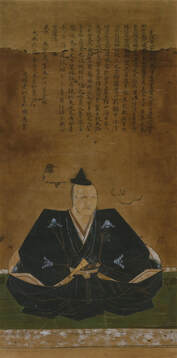
PictureMiyoshi Yukinaga. Source: Wikipedia

Chapter One   The advance from Shikoku (continued from last week)
Miyoshi Yukinaga and the Hosokawa clan
 
1   The Hosokawa, shugo of Awa province, and the Muromachi Bakufu
 
According to the various military tales and genealogies composed about the Miyoshi clan during the Edo period, the Ogasawara of Shinano province were appointed as the shugo (an official position similar to a governor) over Awa province during the Kamakura period. A descendant of that family established himself in Miyoshi-gun (district) at the mouth of the Yoshino river, and there took the surname Miyoshi. 


While it is certainly true that this person belonged to the same family, as is often the case with many of the figures of the Era of the Warring States, it is difficult to verify the validity of claims about origins.
 
A primary source detailing the origins of the Miyoshi first appeared in the latter half of the fifteenth century.  On the 24th of the second month of Kanshō 6 (1465), Inō Shinkaku, the bugyōnin (overseer) appointed by the shugo of Awa province Hosokawa Shigeyuki, ordered one “Miyoshi Shikibu no Shō” to accumulate information about taxation paid across 3-gun districts. In Awa province at the time, the shugodai (a deputy to the shugo) of the Tōjō clan amalgamated a number of provincial districts and appointed either ko-shugodai (an assistant, usually a retainer, to the shugodai) or gundai (district administrators) to each. In the southern gun, Tōjō Wakasa Nyūdō, and in the north and west Miyoshi Shikibu no Shō, were two of these individuals.
 
In the first year of Bunmei (1469), Inō Shinkaku issued a directive to Miyoshi Shikibu no Shō, Kataho Hitachi Nyūdō, and Henmi Bungo Nyūdō to collect tithes from their respective districts.  Kataho was from Izu province and a descendant of a hikan (a retainer granted land and special authority in exchange for military service) of the Hōjō Tokusō clan of the Kamakura Bakufu.  The Henmi clan was from Kai province, and like the Takeda and Ogasawara clans, lay claim to Minamoto no Yoshimitsu as an ancestor.  Both families (Kataho and Henmi) thus bore illustrious lineages, yet if the Miyoshi were also descended from the Ogasawara, wouldn’t it have made more sense for them to also take a surname from a geographical feature in the eastern provinces?
 
Following the chain of logic here, the Miyoshi were most likely kokujin (a prominent local samurai family) in Awa province, who grew in influence to become the gundai of the north western region of Awa. In their search for a more illustrious lineage, many kokujin status families in Awa like the Ichinomiya began to describe themselves as descended from the Ogasawara clan, thus leading to the establishment of the Ogasawara theory of origin.
 
There is also a theory that this Miyoshi Shikibu no Shō was a direct ancestor of Miyoshi Yukinaga, Motonaga and Nagayoshi, each of whom would make their mark in the Kinai region (Yamashiro, Yamato, Settsu, Kawachi, and Izumi provinces).  However all three chose to give themselves the title of ‘Chikuzen no Kami’ (a common practice among prominent military figures of this era was to appoint themselves to positions based on former Imperial titles, in this case ‘kami’. The title held no actual rank, and was more a trend adopted to make one appear more illustrious. Chikuzen is the former name of modern Fukuoka prefecture). While it is possible that the family’s lineage was altered at some point, we do know that in Tenshō 9 (1581) there was still a family by the name of Miyoshi in Awa province using the official title ‘Shikibu no Shō’. Hence the chances that Yukinaga, Motonaga and Nagayoshi had a common ancestor in Shikibu no Shō are rather slim. 
 
It does appear that in the aftermath of the Ōnin War, in the seventeenth year of Bunmei (1485), Hosokawa Nariyuki and his son Masayuki were accompanied by members of the Miyoshi clan in their journey from Kyoto to Awa. So rather than originally being from Awa, there was a Miyoshi family active in Kyoto at the time. It seems more likely that the family of Miyoshi Shikibu no Shō that came to administer the north-western regions of Awa were originally the main branch of the family, while the Miyoshi that later came to adopt the more prestigious title of ‘Chikuzen no Kami’ were retainers in the service of the shugo of Awa province residing in Kyoto. Yukinaga, Motonaga and Nagayoshi were the descendants of these retainers, and during the course of the Era of the Warring States, it was this family that would eventually come to be regarded as the main branch of the Miyoshi clan.
 
The Muromachi Bakufu and the Hosokawa clan
 
The Muromachi Bakufu maintained a policy of dividing up its authority into regions, namely the Kantō, Tōhoku and Kyūshū. To the position of Kamakura Kubō (a position overseeing the administration of 10 provinces in the Kantō region) it appointed the fourth son of Ashikaga Takauji, Ashikaga Motouji, while in relation to the position of Kantō Kanrei (a position providing advice to the Kamakura Kubō and appointed by the shōgun) they appointed the Uesugi clan, a family from whom Takauji’s mother was descended. To the position of Ōshū Tandai (overseeing the far northern provinces) they appointed the Ōsaki clan (a branch of the aristocratic Shiba family), while the Mogami clan (another branch of the Shiba family) were appointed as the Ushū Tandai (the area of north western Honshū now occupied by Akita and Niigata prefectures).   
 
The position of Kyūshū Tandai went to the Shibukawa clan, thereby ensuring that all of these prestigious posts were occupied by illustrious families tied through blood relations to the Ashikaga Bakufu. On the other hand, the Tokai, Hokuriku, Kinnai, Chūgoku and Shikoku regions (known collectively as the Muromachi Dono Gobunkoku) were under the direct control of the shōgun, while the shugo of the same stretch of territory were expected to reside in Kyoto. Those who became shugo included the Akamatsu and Sasaki clans, both of whom had been instrumental in the formation of the Ashikaga Bakufu, and apart from prestigious families dating from the Kamakura era including the Ōuchi, Ōtomo, and Kōno, all fell under the Ashikaga banner. The basic administration adopted by the Bakufu involved shugo combining their responsibilities for numerous provinces throughout the country with control over those same areas, all the while providing the shōgun and the Bakufu government in Kyoto with support.
 
One issue that emerged for the Ashikaga shōgun during the Nanbokuchō period (roughly 1336 to 1392) was how to secure their position while simultaneously fighting both the Southern Court and restraining more influential members of their own family. Their solution was to make the Northern Court appreciate the significance of the role of the shugo, remove the influence of any other branches of the Ashikaga family so that the shōgun monopolized contact with the Emperor, and ensure that only the shōgun’s family occupied high office.

Meanwhile the Hosokawa clan, itself a branch of the Ashikaga family, had pacified Shikoku during Ashikaga Takauji’s retreat to Kyūshū, Through their assistance rendered to Ashikaga Yoshimitsu, Yoshimitsu was able to consolidate the authority of the shōgun. The Hosokawa were, in turn, appointed as senior councilors within the Ashikaga Bakufu. Generations of the Hosokawa clan would take the position title of Ukyō no Daibu (many of the official positions within the Bakufu and imperial system took names derived from Chinese bureaucratic titles), which in time became known as the Ukei chō. The main branch of the Hosokawa family, under the title of Ukei chō, would become one of the three principal families appointed to the position of kanrei (the Sanrankei) together with the Shiba and Hatakeyama. They would then combine their Bakufu duties to simultaneously serve as shugo to the provinces of Settsu, Tanba, Sanuki and Tosa.     
 
The Hosokawa also had their own influential sub-branches of the family. Among those who only served in the position of shugo included the Awa, Awaji, Bichū, Izumi-kami and Izumi-shimo families. Non-shugo branch families such as the Yashū and Tenkyū would serve as retainers to the Ukei chō.
 
At the height of the Muromachi Bakufu, the shōgun held a conference examining important proposals, receiving opinions from a variety of councilors. Those councilors included the sankanrei (see earlier), the Yamana, Isshiki, Akamatsu, and the Awa. In the beginning, these families would wait upon the shōgun, taking up guest spots and holding special status which allowed their attendance at events. With the coming of the Era of the Warring States, these families would be consolidated into the Go shōban shū, a group the membership of which served as proof that one belonged to a powerful, influential clan. The Awa became as renowned as the sankanrei, Yamana, Isshiki, Akamatsu, Kyōgoku, Hatakeyama, and Ōuchi. In other words, the Awa on their own became a mainstay of the Bakufu, one rank below the Ukei chō.
 
The Hosokawa were proud of their strong familial ties. By the mid-fifteenth century, unlike the Hatakeyama that had split into the Masanaga and Yoshihiro factions and fought among themselves, the Hosokawa had emerged as the leaders of the Bakufu government.

The Miyoshi clan of Awa Province

14/11/2023

 
PictureThe Miyoshi clan crest. Source: Wikipedia.
From Amano Tadayuki, "The Miyoshi Clan - The first "Lords of the Realm" of the Warring States Era", Chūōkōron Publishing, Tokyo, 2021

The Miyoshi Family of Awa
 
From the 15th through to the 16th centuries, the Miyoshi became a prominent family, advancing from Awa province on Shikoku Island into the Kinai region, a region that at the time was known as ‘the realm’. ‘Realm’ is a multi-faceted term and can refer in particular to Kyoto, the Kinai region, and Japan in its entirety. During the Era of the Warring States (Sengoku Jidai) it was mostly used to refer to the Kinai.
 
‘Realm’ does not simply designate a region but includes a nuance of centralized political power, in the same way ‘capital’ and ‘central’ is used today. In the area around Kyoto following the Ōnin War (1467-1477), the Miyoshi family were extraordinarily active. Starting with  Miyoshi Yukinaga who led a tokusei ikki (a form of protest against the imposition of land taxes), it extended to Miyoshi Motonaga who recommended that Ashikaga Yoshitsuna (otherwise known as the Sakai Kubō) be elevated to the position of shōgun, to Miyoshi Nagayoshi, who refused to show deference to the Ashikaga shōgunate and came to rule over Kyoto itself, to Miyoshi Yoshitsugu who assassinated shōgun Ashikaga Yoshiteru, to Miyoshi Yasunaga, who adopted both an offspring of Oda Nobunaga and the nephew of Hashiba (Toyotomi) Hideyoshi, through to Miyoshi Isan and Miyoshi Fusakazu, both of whom loyally served Tokugawa Ieyasu.
 
Yet when compared to the families of the eastern provinces such as the Date, Hōjō, Uesugi, and Takeda, and those of the western provinces such as the Mōri, Chōsokabe, and Shimazu, nowadays the Miyoshi are virtually unknown. Why is this?
 
When we think about the Era of the Warring States, we recall that this was the age of the three great figures of Nobunaga, Hideyoshi, and Ieyasu, which also incorporated the Azuchi-Momoyama period. The Miyoshi, who were unrelated to these three great figures, prove poor material when it comes to providing stories for manga, novels, television dramas, historical plays, movies and tourist spots. Yet all versions of the standard high school issue B textbook of Japanese history bring up the Miyoshi. For someone to claim they don’t know who they are should be considered odd.    
 
According to the newly revised version of the “Japanese History B” textbook (published by Jikkyo publishing in 2019), “Hosokawa Harumoto, who successfully managed to subdue Kyoto, had his authority seized by Miyoshi Nagayoshi. Meanwhile the authority of the Miyoshi would in turn be taken over by their retainer Matsunaga Hisahide.” These details have not changed since 1989. Moreover in the ‘Comprehensive Japanese History – Revised Version” (printed by Yamakawa Publishing in 2019), it includes a footnote that states “the struggle over the authority of government centered around the Hosokawa continued unabated”, while in the margins it says “in reality authority shifted from the Hosokawa to Miyoshi Nagayoshi, and then transferred to Nagayoshi’s retainer Matsunaga Hisahide”.
 
In other words, the Miyoshi had no other role than as an example of how retainers such as Matsunaga Hisahide overthrew their social superiors (gekokujō).  
 
When we trace the origins of this line of thinking, we arrive at Ōta Ushikazu (Gyūichi)’s “Taikaou sama kunki no uchi” (A military record of the Taikō, i.e., Toyotomi Hideyoshi) and Raisan Yō’s “Nihon Gaishi” (A history of Japanese foreign relations).  The “military record of the Taikō”, written at the outset of the Edo period (1615-1868) was a compilation of anecdotes about warring state era generals centered around Toyotomi Hideyoshi, and featured embellishments and fabrications. It was to become the basis for narratives and ballads. “A history of Japanese foreign relations” was released in the latter Edo period, and while it is unclear whether it was based on any historical evidence, through stories and ballads its anecdotes grew in popularity and were eagerly absorbed. These in turn became renowned tales that were widely read by the population at large.
 
Most notably, Raisan Yō, who possessed Confucian values, defended the previously reviled Nobunaga by claiming that Nobunaga’s harsh measures were a necessity because of the civil strife of his era. Raisan was also responsible for the formation of a view of Nobunaga, Hideyoshi and Ieyasu as heroic figures struggling against adversity. By and large these views have carried on through to today. For my part, I have never read a primary source that says that Matsunaga Hisahide usurped the Miyoshi.
 
Lecture notes belonging to one of the most prominent scholars of history during the Meiji and Taishō eras, Tanaka Yoshinari, who served as both head of the historical archives and a professor at Tokyo Imperial University, were compiled by his students following his death into the “Ashikaga Jidai Shi” (History of the Ashikaga Era, 1923) and the “Oda Jidai Shi” (History of the Oda Era, 1924). This was a time when historical studies were adopting evidence-based theories. While both works go into considerable detail on the divisions within the Hosokawa family, they note that Miyoshi Motonaga, the father of Miyoshi Nagayoshi, was responsible for the creation of a new political dynamic, but say nothing about either Nagayoshi or Hisahide themselves. Perhaps Tanaka, regarding these two as responsible for nothing more than chaos and decadence, saw no value in speaking about them.    
 
Rather, the “Nippon Kinsei Shi” (History of Early Modern Japan, Vol.1, 1916) which was authored by Nakamura Kōya while he was still studying as a postgraduate at Tokyo Imperial University, regarded Miyoshi Nagayoshi highly. For Nakamura, Nagayoshi was “without peer among the many heroic figures made flesh during the maelstrom of the sixteenth century”. In the Kinki region where he was most active, there existed “a school of thought advocating mature iconoclasm” and was a region suited to the “large scale recruitment of troops”. This ‘shining star’ lacked the forthright nature of figures such as Takeda Shingen, Uesugi Kenshin, Oda Nobunaga, Toyotomi Hideyoshi, and Tokugawa Ieyasu. Yet in terms of political skill he “should indeed be admired”. The fact that he placed his main residence not in Kyoto but at Sekkasen (Izumi province, modern Osaka) was ‘extraordinarily perceptive’.
 
His response to opponents such as Hosokawa Harumoto and Ashikaga Yoshiteru was praised for its “calm repose, thorough preparation, and abundant benevolence”.  Before the war, Nagayoshi “had an established reputation as a calm and composed general that loved poetry”. After the war, most historical study on the Kinki region in the warring states period focused on the Yamashiro kuni ikki (a form of uprising led by regional leaders) and the ikkō ikki (a religiously inspired uprising linked to the Jodō Shinshū faith), as well as the emergence of independent urban areas such as Sakai. Such trends as these had their foundation in the search for the origins of post-war democracy in Japan.
 
As a result of such studies, the picture of the Kinai following the Ōnin War was one where Oda Nobunaga abruptly entered the capital and thereafter embarked on conflict throughout the nation. The history of almost a century of central government that occupied the period in between the two above events was apparently cast aside. Moreover, as a result of movements opposed to the over-concentration of authority in Tokyo during Japan’s period of accelerated economic growth, regional leaders, namely famous warlords from various places throughout the nation, garnered a great amount of attention. Almost concurrent to this trend was another where those like the Miyoshi who were active within the central government faded from view.  
 
With the turn of a new century, studies into the Muromachi Bakufu and shōguns along with those of warlords of the Kinai region evolved, resulting in the publication of a continuous series of books on the subject. Conversely doubts began to be raised regarding both Nobunaga’s foresight and creativity. The image of Nobunaga that we hold today was greatly influenced by Ōta Gyūichi’s “Shinchō Kōki” (Public Records of Nobunaga), resulting in his portrayal as a heroic, albeit somewhat unusual public figure. (The emergence of new studies into the Muromachi period) thus made it possible to compare the era of the Oda with their warlord predecessors in the Kinai region.   
 
Ultimately, to the people of the Muromachi era, the idea of overthrowing the Muromachi Bakufu and uniting the nation was both extraordinary and lacking in common sense.  People today have the benefit of knowing the history of the Kamakura, Muromachi, and Tokugawa bakufunates and how all three were overthrown by force of arms. They then tend to believe that overthrowing the Bakufu was one of the options available at the time. However the overthrow of the Muromachi Bakufu was the first time in Japanese history that this idea became reality.  To directly confront the shōgun and then overthrow him was something that no Japanese had experienced up to this point.  
 
And while all this was going on, there is the added question of how the people at the time accepted a new form of central government in exchange for the old one? What presuppositions and environment led to its formation? In order to consider such questions, there is value in discussing how, over the course of a century in the Kinai region of central Japan otherwise known as ‘the realm’, the Miyoshi dealt with the Muromachi Bakufu and Ashikaga shōgun and then three governments each led by a different ‘heroic figure’ of the age. Let us begin, then, by examining the battles of the Miyoshi family.   


    Author

    This is a blog maintained by Greg Pampling in order to complement his webpage, Pre-Modern Japanese Resources.  All posts are attributable to Mr Pampling alone, and reflect his personal opinion on various aspects of Japanese history and politics (among other things).

    弊ブログをご覧になって頂きまして誠に有難うございます。グレッグ・パンプリングと申します。このブログに記載されている記事は全て我の個人的な意見であり、日本の歴史、又は政治状態、色々な話題について触れています。

    Categories

    All
    Disasters 災害
    Edo Period 江戸時代
    Japan Australia Relations 日豪関係
    Japanese Politics 日本の政治
    Japan Korea Relations 日韓関係
    Kamakura Period 鎌倉時代
    Meiji Period 明治時代
    Miscellaneous 雑学
    Muromachi Period 室町時代
    Regional Politics 地域の政治
    Regional Politics 地域の政治
    Second World War 太平洋戦争
    Sengoku Period 戦国時代

    Archives

    June 2024
    May 2024
    November 2023
    January 2023
    January 2022
    December 2021
    August 2021
    October 2020
    September 2020
    July 2020
    May 2020
    April 2020
    March 2020
    December 2019
    July 2019
    February 2019
    December 2018
    November 2018
    September 2018
    August 2018
    July 2018
    June 2018
    May 2018
    April 2018
    March 2018
    February 2018
    January 2018
    December 2017
    November 2017
    October 2017
    September 2017
    July 2017
    June 2017
    March 2017
    January 2017
    August 2016
    July 2016
    June 2016
    May 2016
    April 2016
    March 2016
    February 2016
    January 2016
    December 2015
    November 2015
    October 2015
    September 2015
    August 2015
    July 2015
    June 2015
    May 2015
    April 2015
    March 2015
    February 2015
    January 2015
    December 2014
    November 2014
    October 2014
    September 2014
    August 2014
    July 2014
    June 2014
    May 2014
    April 2014
    March 2014
    February 2014
    January 2014
    December 2013
    November 2013
    October 2013
    September 2013
    August 2013
    July 2013
    June 2013
    May 2013
    April 2013
    March 2013
    February 2013
    January 2013
    December 2012
    November 2012
    October 2012
    September 2012
    August 2012
    July 2012
    June 2012
    May 2012

    RSS Feed

© 2025 www.farbeyondthemiyako.com. All Rights Reserved.