遠々洛外
  • 遠々洛外のブログ - Far Beyond the Miyako Blog

Abe and the 2017 election

24/10/2017

 
PictureSource:www.huffingtonpost.jp
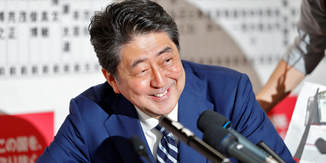
So PM Abe has retained his position as PM and the LDP/Komeito has a super-majority in the Diet (313 seats) which, theoretically, gives them the numbers to push ahead with constitutional re-writing to legally establish the legitimacy of the SDF as an armed force and its role in the protection of the Japanese state. For PM Abe the gamble of going to the polls in the wake of scandal and the emergence of a potential rival in the Party of Hope was balanced by the positive economic data on the Japanese economy released earlier this month combined with the both real and existential threat posed by North Korea. These factors, combined with the appearance over the weekend of an intense typhoon that kept many voters from venturing outdoors, brought about a victory that had been expected to return the LDP/Komeito to power, but far greater in numbers than anticipated (the rate of voter turnout was the second lowest in postwar Japanese history, however).

While PM Abe himself has lost popularity in recent months, it appears that the disarray in the opposition parties, the lack of a truly viable centre or centre-left alternative to the LDP/Komeito coalition, and sheer voter apathy have returned the incumbent government to power for a fourth term. Abe is set to become the longest ever serving Japanese prime minister, surpassing both his grandfather and great uncle, and may also be the first Japanese prime minister in the post-war era to successfully re-write the constitution. Both of these will certainly cement Abe’s legacy in history, but whether they are in the best interests of the nation remains to be seen.  From the numerous polls conducted during the election campaign, it is clear that voters were looking for something to rejuvenate Japan’s political environment, but the lack of choice in realistic, or at least promising alternatives meant that voters faced the choice of either merely returning the current government or not bothering to vote at all. 

So the question that is now being banded around social and traditional media is whether Abe has the ability to go ahead with constitutional reform. All of the legal measures are in place to allow it occur, but the next step may be the toughest of all – convincing a skeptical Japanese public that revisionism is in fact necessary, and that by re-writing the constitution Japan will be better protected against external threats from neighboring states.  The Japanese public is split on the issue, and only an overwhelming majority in favour can lead the way to approval to re-word the constitution. Then again, if North Korea continues to keep shooting missiles in the direction of Japan then the public just might see the logic of changing the constitution, although it would do little to assuage the belief that the North Korean issue is a useful expedient for changing the constitution along the lines of the central-right ideology of the LDP.

In the meantime the issue of disproportionate representation has once again emerged in the wake of the 2017 election in the same manner that it did following the 2009, 2012, and 2014 elections. The Supreme Court ruled in each occasion that the election had occurred in an ‘unconstitutional’ manner because of the disparity in weighting for votes. A group of constitutional lawyers have again submitted writs to courts across the country in an attempt to have the election declared void, however this activity usually results in the Supreme Court ruling that while the result is unconstitutional in nature, it is still valid. The reasoning behind this says that declaring the result invalid and void would result in administrative chaos and have a negative effect on markets, thereby harming the state. So the result will stand, and the issue will continue to plague every federal election until it is resolved, one way or another.

From the point of view of bilateral relations, the re-election of PM Abe doesn’t change the dynamic between Australia and Japan. It will continue as per usual, although it might see more activity such as joint exercises between the armed forces of both countries, and possible co-ordination on ensuring the TPP is approved by the remaining 11 (possibly 10, depending on how New Zealand goes under the Ardern government) participating nations. The real question for bilateral relations is the longevity of the Turnbull government, but that is a question better addressed by other blogs.   

The renegade in the Upper House

19/10/2017

 
Picturewww.MSN.com
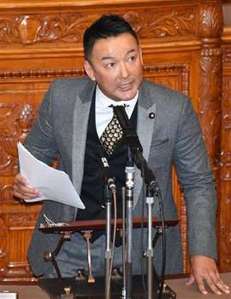
Over the past few years, as certainly since the mid-2000s, Yamamoto Taro has been making a name for himself as an actor, television personality and a politician with strong convictions. Personally, I first became of aware of Yamamoto through his performance in NHK’s 2004 historical drama “Shinsengumi!”(as Harada Sanosuke), however since 2011 it has been his political activism which has garnered the most public attention . Yamamoto was very publicly vocal in his opposition to Japan restarting its nuclear power plants in the aftermath of the Fukushima disaster, so much so that in the 2012 House of Representatives election he stood as an independent under the banner of his own party, the curiously named “New Party of One”, which took the abolition of nuclear power stations and transferal to renewable energies as its main platform. While he didn’t succeed on this occasion, his subsequent candidacy for the 2013 House of Councilors election (where he again ran as an independent) garnered enough votes to see him elected as a representative for the Tokyo metropolitan area.    

While Yamamoto is currently a representative of the Liberal Party (together with party leader Ozawa Ichiro), he has formed numerous  alliances over the past five years with the DPJ, Unity Party, New Socialist Party of Japan, and the Greens Japan, to name just a few. Yamamoto has primarily set himself against what he perceives to be the vested interests in Japan that ignore the general welfare of the people, particularly the right-wing, conservative agenda of the ruling LDP and Komeito parties. Yamamoto has voiced his opposition to the Abe government’s attempts at constitutional revision, its endorsement of the TPP, and its moves to restrict access to public information and strengthen national security laws. Furthermore, in 2013 Yamamoto made a name for himself by presenting a letter in person to Emperor Akihito at the Enyukai, an annual formal reception hosted by the Emperor, in which he advocated that Japan cease relying on nuclear energy by detailing the damage inflicted on Fukushima Prefecture and that under conservative governments the country was in danger of receding to a pre-war state of ignorance (an act for which he was reprimanded by the House of Councilors).

Yamamoto is unapologetic about his anti-conservative (or more correctly, anti-right wing) stance, going so far as to ridicule PM Shinzo Abe’s wife Akie Abe’s involvement in the Moritomo Gakuen scandal by referring to it as the “Ak-heed Scandal”, a reference to the Lockheed scandal of the mid 1970s that brought down then sitting PM Tanaka Kakuei (which elicited a sharp rebuke from PM Abe).  He has previously criticized NHK for being far too lenient towards the LDP in its questioning of the Kakei and Moritomo scandals (and called for viewers to boycott paying compulsory subscription fees to the national broadcaster), and has also criticized the continuation of whaling, the forced removal of homeless from Olympic venue sites, the Abe government’s decision not to enact (i.e., bring into force) the Paris Climate Agreement,  and is against PM Abe or members of his government paying visits to Yasukuni Shrine.

Yamamoto’s role seems to be one of, to use an Australian vernacular expression, “keeping the bastards honest”, pursuing the government on issues of social inclusion and the role of the state as well as reminding the government of its responsibility to its citizenry. This has made him a favourite target for right wing pundits and nationalist commentators, but it hasn’t dampened his enthusiasm for tackling subjects that might otherwise never see the light of day, and Japan politics is all the better for it.


Just in it for the money...

11/10/2017

 
PictureSupport for the Abe government. Source: https://www.nhk.or.jp/senkyo/shijiritsu/
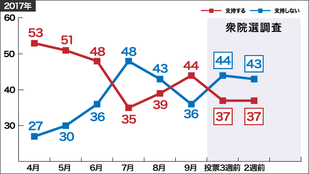
With the 2017 House of Representatives election kicking off in predictable style on Tuesday, NHK published the results of a public opinion poll carried out last week. It showed that 56% of voters do plan to go to a polling station on election day, a 3 point rise from the previous poll. Of particular interest was the number of people expressing support for the Abe government was unchanged from last week at 37%, while the number of respondents expressing dissatisfaction with the current cabinet stood at 43%, one percentage point down from last week. The poll also revealed that while 32% of respondents expressed a great amount of interest in the current election, 44% said they had some interest, with a further 16% saying they didn’t really have much interest at all. Furthermore, while 23% of respondents thought that PM Abe’s decision to go to the polls had some merit, 34% thought that there was little merit, while 31% thought there was no merit in calling an election at all.

However, when turning to support for political parties, it is clear that the LDP has little to fear in terms of a backlash against their decision to go to the polls, with 31.2% of respondents expressing support for the LDP with another 3.8% in favour of the Komeito. The next closest challenger, the Party of Hope, languishes at 4.8%, with the Japanese Communist Party coming in behind the Komeito at 2.7%. At this rate the election looks as though it will follow current trends – lax voter interest, coupled with no real alternatives to the ruling parties’ policies, will inevitably lead to the re-election of the incumbent government. If change is to happen, then it will depend on whether any of the minor parties can persuade the 39.1% of respondents who have not expressed support for any particular party to suddenly shift their position. The numbers don’t suggest this is possible, but one can never rule out a surprise result.

What might raise a few voter hackles is the fact that there are 83 members of the House of Reps who have neither put forward any legislation nor asked any questions during the course of the year.  When considering that each member of the House of Representatives earns an annual salary of 20 million yen, coupled with an extra 12 million yen per annum tax-free subsidy for “documentation, travel and accommodation”, the absence of any record of Diet activity by such representatives might be cause to doubt their motives for entering politics. While the inclusion of Ozawa Ichirō is more a reflection of his fall from popular grace (his party, the Liberal Party, is currently polling at 0% support among voters, and in its current form the Liberals are unlikely to garner any further public interest in their policies by October 22), and many members might involve themselves in activities for their respective parties without being active in the Diet, the presence of so many members devoid of achievements, or even an active voice, in the Diet serves as point of contention among voters regarding the usefulness of their elected representatives.


Dreams of a Red future...

5/10/2017

 
PictureSource: www.jiji.com
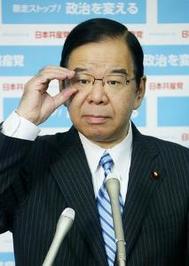
With a majority of news on the Japanese House of Representatives election focused on the merger between what was left of the DP under Maehara Seiji with the Party of Hope under Koike Yuriko, and the subsequent emergence of a new leftist party, the Constitutional Democratic Party of Japan, among whose members are former DPJ cabinet secretary Edano Yukio and former DPJ PM Kan Naoto, I wanted to take a quick look at what is really the only alternative party left for those who choose to neither vote for the LDP/Komeito Coalition nor for the (recently expanded) Party of Hope on October 22nd .  I am talking, obviously, about the Japanese Communist Party.

Polling for the JCP has placed them at 4.9%, 5.8%, 5%, on par or slightly above the Komeito but significantly behind the two leading parties. Not for a moment am I suggesting that the JCP has any chance of pulling off an electoral miracle and bring down the incumbent LDP, but for the 40% or so undecided voters within the Japanese electoral system, any protest vote that they might want to make against either the LDP or its offshoots (which includes the Party of Hope, whose own policies either mirror or exceed in severity those of the LDP) will probably go to the JCP.

The JCP has been doing its utmost to tap into this dissatisfaction. Its party platform going into the election is basically a mix of “stop the reckless Abe government” and using citizen and opposition co-operation to bring about change (by imitating the Tokyo metropolitan election result at a national level). This is in addition to vowing to halt the LDP/Komeito attempts at constitutional revision and repeal its security laws, prevent the acquisition of nuclear weapons, stop any attempt to restart Japan’s nuclear power plants, eliminate discrimination against women and uphold human rights, protect citizens from natural disasters, and bring up the issues of Abe’s involvement in the Moritomo and Kake Gakuen scandals to prevent any attempted privatization of public assests.

Whether or not any of this will resonate with the population as a whole is debatable, particularly when the threat of North Korea looms large (indeed, the timing of the election has raised questions and the ire of commentators who believe it is little more than an attempt by PM Abe to exploit divisions among opposition parties and the threat of North Korea, thereby securing a third term for Abe and cementing a legacy for himself as Japan’s longest serving PM).

Yet with its anti-militaristic, anti-US, anti-capitalism advocacy, its trumpeting of social values and the strength of the community and its fierce defence of constitutionalism, the JCP represents a very real alternative voters may be seeking if they wish to unsettle the ruling parties. Voting for the JCP would require a leap of faith in voters to challenge the political arguments put forward by the LDP/Komeito over the past 5 years, a task made more difficult by the regulated nature of political coverage in Japan which limits the expression of alternative views to those of the government in public (not to mention the inherent conservatism of Japanese voting patterns). But the arguments of JCP politicians, particularly those of Party leader Shii Kazuo, who has been fighting against both LDP/Komeito and DPJ governments as leader since 2000, might just lead the party to gain an extra seat in the Lower House, draining some votes away from both the LDP and the Party of Hope and making the JCP the true alternative to the political mainstream.

Whether or not the Japanese population is prepared to embrace its own form of populism is unknown, but if enough of the voting public are concerned about the direction of Japanese society and are determined to bring about a radical transformation in its current path, a vote for the JCP would be one powerful way to achieve this.       


    Author

    This is a blog maintained by Greg Pampling in order to complement his webpage, Pre-Modern Japanese Resources.  All posts are attributable to Mr Pampling alone, and reflect his personal opinion on various aspects of Japanese history and politics (among other things).

    弊ブログをご覧になって頂きまして誠に有難うございます。グレッグ・パンプリングと申します。このブログに記載されている記事は全て我の個人的な意見であり、日本の歴史、又は政治状態、色々な話題について触れています。

    Categories

    All
    Disasters 災害
    Edo Period 江戸時代
    Japan Australia Relations 日豪関係
    Japanese Politics 日本の政治
    Japan Korea Relations 日韓関係
    Kamakura Period 鎌倉時代
    Meiji Period 明治時代
    Miscellaneous 雑学
    Muromachi Period 室町時代
    Regional Politics 地域の政治
    Regional Politics 地域の政治
    Second World War 太平洋戦争
    Sengoku Period 戦国時代

    Archives

    June 2024
    May 2024
    November 2023
    January 2023
    January 2022
    December 2021
    August 2021
    October 2020
    September 2020
    July 2020
    May 2020
    April 2020
    March 2020
    December 2019
    July 2019
    February 2019
    December 2018
    November 2018
    September 2018
    August 2018
    July 2018
    June 2018
    May 2018
    April 2018
    March 2018
    February 2018
    January 2018
    December 2017
    November 2017
    October 2017
    September 2017
    July 2017
    June 2017
    March 2017
    January 2017
    August 2016
    July 2016
    June 2016
    May 2016
    April 2016
    March 2016
    February 2016
    January 2016
    December 2015
    November 2015
    October 2015
    September 2015
    August 2015
    July 2015
    June 2015
    May 2015
    April 2015
    March 2015
    February 2015
    January 2015
    December 2014
    November 2014
    October 2014
    September 2014
    August 2014
    July 2014
    June 2014
    May 2014
    April 2014
    March 2014
    February 2014
    January 2014
    December 2013
    November 2013
    October 2013
    September 2013
    August 2013
    July 2013
    June 2013
    May 2013
    April 2013
    March 2013
    February 2013
    January 2013
    December 2012
    November 2012
    October 2012
    September 2012
    August 2012
    July 2012
    June 2012
    May 2012

    RSS Feed

© 2025 www.farbeyondthemiyako.com. All Rights Reserved.