遠々洛外
  • 遠々洛外のブログ - Far Beyond the Miyako Blog

Alliances and freedom of expression

30/6/2015

 
Picturewww.asahi.com
Over the past year, media commentary about the growth of Japan-Australia ties has often posed the question of whether Australia and Japan should formally establish an alliance. Following a report in last weekend’s  Australian newspaper ($) which addressed that very question (with the interesting quote from Funabashi Yoichi that Japanese officials already refer to the relationship as a “quasi alliance”), I thought it might be useful to gather together the various pros and cons concerning the creation of an alliance, based on the content of the debate in Australia, and quickly jot them down in point form so that any casual observer would be able to see at a glance what the issues are.   

Why Japan and Australia should/should not become allies

In favour of an alliance:

1. Both countries are democracies, with respect for the rule of law

2. Both are allies of the US, and so have a mutual ‘major benefactor’ and a history of operating with one another in conjunction with the US

3. Have enjoyed over 60+ years of progressive economic and diplomatic relations

4. Have mutually beneficial aspects to their economies – Japan in manufacturing, Australia in raw materials

5. Personal relations between citizens of both countries are cordial and friendly

6. Both nations depend heavily on seaborne trade, and have interests in maintenance of freedom of navigation on the sea

7. Both nations engage in and assist one another in humanitarian and disaster response exercises and operations in the Pacific and further abroad

8. Both nations belong to major multilateral regional forums and organisations, and pursue similar policies in these institutions

Against an alliance:

1. Japan has territorial issues with other major Asian nations that could drag Australia into a regional conflict against its interests

2. An alliance with Japan would gravely upset China, creating tension with Australia’s largest trading partner

3. It is not an even partnership – Japan has a vastly larger military with greater capabilities than Australia’s. Australia would not bring much to the table in terms of capabilities that Japan couldn’t already get from its alliance with the US

4. Domestic populations of both countries have not explored the possibility of an alliance, and it would be unlikely to have much support. Japan’s population is still wrestling with the implications of collective self defence, hence an alliance would be too much, too soon

5. Historically, Australia has never had a major alliance with a nation in Asia. Setting a precedent takes strong political will and a strong majority in parliament, and that is not be available at present

6. Historically, Japan has relied solely on its alliance with the US for its security for the past 60+ years. It has no recent history of an alliance outside of that with the US, and Australia’s regional relations (i.e., its exposure to China’s economic influence) might cause Tokyo to hesitate pursuing any closer ties

Questions on Freedom of Expression

To continue, in the past week Japan, and Japan's media in particular, have been wrestling with questions related to the freedom of expression as it is practised in Japan - in particular the degree of commitment that certain parliamentarians and commentators have to Article 21 of the Japanese Constitution.

The first of these controversies occurred in the wake of PM Shinzo Abe’s visit to Okinawa last week to attend a commemoration ceremony marking the 70th anniversary of the Okinawa campaign. In the course of delivering his speech, PM Abe was heckled by members of the crowd angry at his government’s move to change the interpretation of Article 9 of the Constitution and recognise collective self defence, in addition to the federal government’s stubborn determination to continue constructing new military facilities at the Henoko  site in northern Okinawa despite opposition from Okinawan governor Onaga Takeshi.

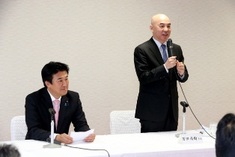
Local Okinawan newspapers, namely the Ryūkyū Shinpo and  the Okinawan Times, have been strong supporters of the anti-base movement and of the position taken by Governor Onaga.  This appears to have made them targets of comments attributed to Hyakuta Naoki, a right-wing author and commentator with close ties to the Abe administration. At a study session of young members of the LDP (the so-called “Culture and Arts Study Group”), Hyakuta, as an invited guest, said that both newspapers “should be crushed” (J), a  statement he later claimed was made in jest and that was off the record.  

Hyakuta’s commentary was controversial enough for PM Abe to have to come out to reinforce his government’s support for freedom of the press and note the role of freedom of expression as a fundamental pillar of democracy (J). Nevertheless, the same study session also saw, Kihara Minoru, head of the Young LDP, state that restrictions should be placed on the media (J). This set of a wave of criticism within the media of both Kihara and the LDP when it was made public, so much so that LDP executive was forced to suspend Kihara’s chairmanship of the study group (J) and once again reiterate the government’s commitment to all forms of democratic expression (J).

Memories of the restrictions on reporting imposed on newspapers during the early Shōwa era still abound in Japan, hence any mention of restricting the public’s right to information is met with incredulity and anger both by media organisations themselves and the wider public. Given Japan is still debating the implications of collective self defence, to have members of the government and their affiliates start discussing limitations on the “right to know” was poor timing, to say the least.

Polls released by the Nikkei Shimbun this week indicate that PM Abe is having a hard time selling the concept of collective self defence to the Japanese population, hence any suggestion that the government might contemplate shutting down any criticism of its policies would naturally be a cause for grave concern. While this issue might fade away, it will remain at the back of many minds both within the media and academia concerned about the direction the domestic debate on self defence has taken and whether the Abe government’s intentions are being revealed to the public in full.   

Hideyoshi’s Propaganda Vehicle – the “Koretōtaijiki”

24/6/2015

 
Pictureeikojuku.seesaa.net
So, who was it that first started propagating this fiction as “fact”? It was none other than Hashiba Hideyoshi, or as he later became known, Toyotomi Hideyoshi. 

The strange thing about this is that virtually no one knows about it.

“Now is the time, the fifth month, when I stand beneath the rain”

The above verse is widely regarded as evidence of Mitsuhide’s decision to plot against Nobunaga. The verse was composed at a “Renka” (or poetic verse) gathering known as the “Atago Hyakuin” (because it took place on Mt Atago). The location was close to Mitsuhide’s home castle at Tanba Kameyama (now part of Kyoto Prefecture), and occurred three days before the Honnōji Incident. (p.23)

Why was it that this verse in particular became so widely known? In modern times, when a major incident takes place news organisations rapidly gather up information while local information takes a little longer to reach the community.  At the time of the Honnōji Incident there were no mass media organisations.  It should have been impossible for the specific circumstances of an incident to be so widely known in such a short space of time. Yet the above verse, known as “Mitsuhide’s verse”, was widely acknowledged as revealing Mitsuhide’s mindset before the events at Honnōji took place. (p.24)

And where was this particular verse to be found? In a document known as the Koretōtaijiki (A Record of the Elimination of Koretō). 

The “Koretōtaijiki” was composed four months after the Honnōji Incident in the 10th month of Tenshō 10 (1582). It was written by one Ōmura Yūko, a member of Hashiba Hideyoshi’s Otogishū group of retainers. It is a relatively short document, only 20 pages long, but contains all of the details of the Honnōji Incident from start to finish, thus making it a compact “after-action report”.  Incidentally, the “Otogishū” were retainers who prided themselves on their talent for writing, and who often became conversation partners for their lord. They fulfilled a role not unlike that of a modern day PR firm.(p.24)

“Koretō” was a surname given to Mitsuhide by the Imperial Court, while “Taiji” refers, just as the title suggests, to Hideyoshi’s defeat and destruction of Mitsuhide following the battle of Yamazaki, and is a kind of “propaganda” tool. This document was the earliest to be distributed after the Honnōji Incident, and was the ‘official’ version of the events surrounding the incident according to Hideyoshi.  The document publicly established Mitsuhide as the sole conspirator in the plot against Nobunaga, portrayed Mitsuhide as being driven by a personal grudge against Nobunaga, and declared that Mitsuhide harboured his own ambition to gain control of the realm.(pp.24-25)

The evidence that Hideyoshi produced to prove that Mitsuhide was bent on seizing the realm was “Mitsuhide’s verse”. The Koretōtaijiki described it as thus:

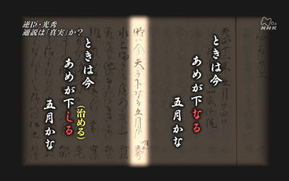
「光秀発句に曰く、時は今あめが下しる五月かな」”As Mitsuhide said, now it is the time, the fifth month, when I stand beneath the rain” (p.25)

This particular verse could be interpreted as saying that “Now I am intent on betrayal, and am prepared to go ahead with it with whomever will join me”. Then again, if we interpret “Mitsuhide’s verse” exactly as written, it says “Right now, as a stand beneath the rain of the fifth month, I am aware that it is indeed the fifth month”. In other words, Mitsuhide was commenting on the characteristics of the rain in the fifth month. (p.25)

However Hideyoshi, using the Koretōtaijiki, did not ascribe to this ostensible interpretation, and changed the meaning of the characters so that “時” instead referred to “土岐” (the surname of a daimyo family related to Mitsuhide, pronounced the same as 時), “あめが下” meant “天下” (or realm),  and “しる” meant “統べる” (to pacify). Hence according to Hideyoshi’s reading, the verse read “I (Mitsuhide), of the Toki family, should pacify the realm in this the fifth month”, and was evidence of Mitsuhide’s conspiracy against Nobunaga.(p.25)

Yet the “Mitsuhide’s verse” quoted above is not the only one in existence. In truth, there are around 10 or so copies of the Atago Hyakuin collection of poetic verse. In one copy, kept in the vaults of the Kyoto University Library collection, the section that contains the verb “下しる” is rendered as “下なる”.  That particular version’s verse reads as follows:

「時は今あめが下なる五月かな」”It is now the fifth month when the rain falls”

In other words, this verse is saying “Now it is the fifth month, when the rain of the fifth month falls”. If Mitsuhide intended the verse to be read as “beneath the rain”, then this would literally mean “I am beneath the rain”, and so would be in accordance with the Koretōtaijiki’s interpretation of the verse, which was “It is now the fifth month when I must pacify the realm”. (p.25)

So, which reading of the verse was the one that Mitsuhide intended? Why don’t we make a blank slate of the almost four hundred year reading of “下しる” and give this issue a bit of consideration?  To jump to the conclusion first, it is beyond doubt that Mitsuhide intended the verse to be read as “the fifth month when the rain falls”.  As for why this is the case, the fact is that the reading in the Koretōijiki, i.e., “beneath the rain of the fifth month”, is completely contradictory. (p.26)

Let us accept for a moment the reading of the verse in the Koretōtaijiki, that which says “I, of the Toki family, will pacify the realm in this the fifth month”. Well then, what month did the Honnōji Incident occur in? The Honnōji Incident took place on the second day of the sixth month; not the fifth month, the six month.  If the Honnōji Incident took place in the sixth month, then it does not match the time frame included in the Koretōtaijiki.  It is a minor point, but in investigating history one cannot afford to overlook any minor points. It is the same as any criminal investigation carried out in modern times. (p.26)

Even if the Atago Hyakuin had been donated to Atago shrine, given that the god of the shrine was venerated for bringing victory in battle, such a ridiculous offering would be completely out of order. The Koretōtaijiki reading should be regarded as a blatant attempt to re-interpret the words of the verse, a re-interpretation that gave way to a contradiction. (p.26)


False premises concerning Mitsuhide's motivations

15/6/2015

 
PictureMorimiya.net
Quite some time ago, I introduced on this blog a book written by Akechi Kensaburō titled ‘本能寺の変―四二七年目の真実’ (The ‘427 year truth of the Honnōji Incident’). This book outlined Kensaburō’s own theory as to why Akechi Mitsuhide chose to attack the temple of Honnōji in Kyoto, an act that led to the death of Oda Nobunaga and temporarily derailed the course of unification pursued by a generation of warriors from Owari and Mikawa provinces. According to Kensaburō’s theory, Akechi Mitsuhide shared blood ties with members of the Gifu province elite who swore allegiance to Shōgun Ashikaga Yoshiaki. When Nobunaga planned to invade Shikoku in order to overthrow some of these relatives (namely the Chōsokabe family), Mitsuhide had no choice but to act in defence of familial interests, eliminating Nobunaga and preparing for the restoration of the Ashikaga shōgunate.

However Hashiba (later Toyotomi) Hideyoshi, having received word of Akechi’s betrayal, withdrew from a campaign against the Mōri in western Japan to return to the central provinces (中国大返し) and confront Mitsuhide, a lightening campaign that ended in the battle of Yamazaki and the death of Mitsuhide.

This conclusion was quite revelatory for its time, as most history textbooks in Japan emphasise that Mitsuhide was ‘acting alone’, that he bore a grudge against Nobunaga out of some perceived slight, and so his treachery was all the more heinous considering the trust that Nobunaga had shown in him.  Mitsuhide was, in other words, justly punished for his betrayal.

In his latest work titled 「本能寺の変 431年目の真実」, Kensaburō explores the premise of his theory a little further in light of recent evidence. As part of that process, Kensaburō explains why it was that the ‘villain’ theory came to be so widely believed and who had a hand in perpetrating it. All evidence, or at least the evidence that Kensaburō chooses to detail in his work, points towards Hashiba Hideyoshi commissioning historical records that lay all of the blame for the incident on Mitsuhide. I’ve translated part of the first chapter of the book, mainly because this is the part that details Hideyoshi’s attempt at historical revisionism, and because it’s a fairly interesting introduction to the subject.

  Chapter One  “Who was responsible for creating the established myth?”

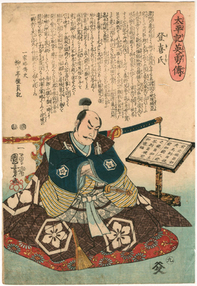
In the early hours of the 2nd of the 6th month, Tenshō 10 (1582), the temple of Honnōji in Kyoto was surrounded by the forces of Akechi Mitsuhide. After a brief fight, the temple was engulfed in flames, and Oda Nobunaga, who dreamt of one day uniting the nation, met his fate at the age of 49.  Mitsuhide’s army then moved on to surround the palatial residence at Nijō which housed Nobunaga’s son and heir, Nobutada. With no means of escape, Nobutada ended his life by his own hand, and thus Mitsuhide brought the ‘Honnōji Incident’ to a successful conclusion. (p.21)

Just 11 days later on the 13th of the 6th month, Mitsuhide fought the battle of Yamazaki against Hashiba Hideyoshi.  Mitsuhide was defeated, and it was while he was retreating to his residential castle at Sakamoto in Ōmi province (modern day Shiga prefecture) that Mitsuhide was slain by a person or persons unknown.  These then are the predominant details of the Honnōji Incident, and the battle of Yamazaki. (p.21)

While the above information is certainly true, many people share theories and stories concerning both events that are accepted as historical fact. For example, Nobunaga apparently offered some harsh criticism of Mitsuhide’s actions. Incensed by this, Mitsuhide plotted Nobunaga’s downfall.  This decision was apparently foretold in a poem written by Mitsuhide, which said that ‘perhaps the time is now, when the rains of the 5th month (Satsuki) are falling’. Mitsuhide was alone in his plan to remove Nobunaga, and did not reveal this to his retainers until immediately before setting out for Honnōji, uttering the words “the enemy is in Honnōji” (敵は本能寺にあり). Hashiba Hideyoshi, who was in camp at Takamatsu in Bichū province at the time, learnt of Nobunaga’s demise, and with tears in his eyes solemnly vowed that he would display his loyalty by cutting down his lord’s killer. (p.22)

Everything that has just been outlined about the Honnōji Incident is an invention. They are no more than fabricated stories included in a war tale written some decades after the Honnōji Incident, during the Edō period (1615-1868).

Why is it that written records of the Honnōji Incident, whether they were written decades or centuries after the events they portray, all say the same thing? Was it because they were closest to the truth?

The reality is that these tales were ‘promoted as the truth’.  A certain person, a mere four months after the Honnōji Incident, invented the idea that Mitsuhide held a grudge against Nobunaga and had ambitions of his own to become ruler of the nation. This person also wrote that Mitsuhide acted alone in his conspiracy, and promoted this view to the public. In an age when mass communications and a liberal media were unheard of, whomever held power could create whatever ‘truth’ they wished and this would be accepted as the ‘truth’.  War tales in particular would pick up whatever information was available and then use it to expand a story – for example “Mitsuhide became a close confidant of Tokugawa Ieyasu at Azuchi castle which was resented by Nobunaga”, “Mitsuhide was bad mouthed by Nobunaga and physically assaulted by him”, “Mitsuhide was forced to relinquish much of his territory by order of Nobunaga”, “It was Nobunaga’s fault that Mitsuhide’s mother was killed” etc.  All of these stories were gradually inflated.

Even today, there are a number of people who continue to attach new theories to the reasons why Nobunaga hated Mitsuhide and why Mitsuhide loathed Nobunaga – there’s even one which says that the reason Nobunaga disliked Mitsuhide was because he (Mitsuhide) was short-sighted. It seems that as long as it’s entertaining then anything goes. (p.22)

(TBC)


Andrews in Japan, and parliamentary behaviour

2/6/2015

 
PictureTokyo Shimbun
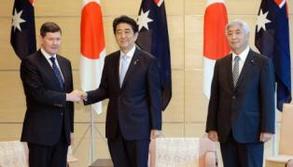
To get this show on the road for this week, I thought I start with a quick summary of an Kyodo Press article concerning the visit to Japan this week by Australian Defence Minister Kevin Andrews, who has been touring submarine manufacturing yards in Kobe and other domestic shipbuilding infrastructure in Japan as part of the Australian government’s ‘competitive evaluation process’ for its Future Submarine Program.

The original Kyodo article is reproduced below in full (via the Tokyo Shimbun website):

安倍晋三首相は3日、オーストラリアのアンドリュース国防相と官邸で会談し、安全保障法制整備による自衛隊の任務拡大を念頭に防衛協力を強化する方針で一致した。北朝鮮の核・ミサイル問題や、中国の海洋進出など安保環境の変化を踏まえ、緊密に連携することも確認。

 首相は「両国は、普遍的価値と戦略的利益を共有する『特別な関係』だ。その関係をますます強固なものにしていきたい」と強調。両国の防衛協力について「両国の国益のみならず、地域の平和と安定に大きく寄与するものだ」と指摘した。アンドリュース氏は「2国間のみではなく、日米豪3カ国の協力も大変重要だ」と応じた。

(Translation: Prime Minister Shinzo Abe held discussions with Australian Defence Minister Andrews on the 3rd at the Prime Ministerial Residence.  Both sides agreed to strengthen policies on defence cooperation, while keeping in mind an expansion in the activities of the SDF as a result of reform of security legislation.  Both sides also confirmed that they would remain in close consultation regarding North Korea’s nuclear and missile programs, China’s maritime foray and changes in the regional security environment, among others.

PM Abe emphasised that “Both countries have a ‘special relationship’ encompassing shared values and strategic interests. I would like to further strengthen this relationship”. In regard to defence cooperation between both countries, PM Abe indicated that “This is not only for the benefit of both countries, but will make a significant contribution to the peace and stability of the region”. In response, Minister Andrews said “Not only bilateral, but trilateral cooperation is vital between Japan, the US, and Australia”.)

While this appears to be a standard response to questions regarding Australia-Japan defence ties, the statement by PM Abe that he wants to ‘further strengthen’ the relationship should be taken as an indication that cooperation between both nations is about to be stepped up. Following last week’s Shangri-La Dialogue, in which Australia and Japan’s positions on China’s island building in the South China Sea were virtually identical, one can assume that this level of shared concern will translate into further exercises involving the SDF and ADF, with the ADF possibly going to Japan to learn more of the SDF’s capabilities and procedures.

Yet this is not the only area that caught my attention this week. Another concerned the behaviour of PM Abe during questioning from opposition parties earlier this week as part of the Diet’s debate on Japan’s security laws (J).  Apparently PM Abe was a little more bellicose than opposition members were prepared to tolerate, answering questions directed at Defence Minister Nakatani despite no request to do so, and heckling the opposition with “Hurry up and ask your question!” when members took longer than expected to make a point. Naturally this then resulted in a wave of heckling from the opposition seats directed at PM Abe and brought all questions to a halt. 

In terms of parliamentary behaviour, especially when compared to that of other parliaments around the world, it was hardly out of line, and certainly wouldn’t batter an eyelid in Australia’s often terse political debates. Yet it has raised the heckles of left-wing newspapers in Japan, who regard it as evidence of PM Abe’s ‘arrogance’ and evasiveness when it comes to questions on collective self defence.  While Abe is no ‘innovator’ in terms of riling up the opposition (PMs Nakasone and Koizumi were also quite deft at it), it is far more ‘civil’ than past behaviour exhibited in the Diet, where physical tussles between members over legislation is not unknown, as demonstrated by this video (skip to 0:13)    


    Author

    This is a blog maintained by Greg Pampling in order to complement his webpage, Pre-Modern Japanese Resources.  All posts are attributable to Mr Pampling alone, and reflect his personal opinion on various aspects of Japanese history and politics (among other things).

    弊ブログをご覧になって頂きまして誠に有難うございます。グレッグ・パンプリングと申します。このブログに記載されている記事は全て我の個人的な意見であり、日本の歴史、又は政治状態、色々な話題について触れています。

    Categories

    All
    Disasters 災害
    Edo Period 江戸時代
    Japan Australia Relations 日豪関係
    Japanese Politics 日本の政治
    Japan Korea Relations 日韓関係
    Kamakura Period 鎌倉時代
    Meiji Period 明治時代
    Miscellaneous 雑学
    Muromachi Period 室町時代
    Regional Politics 地域の政治
    Regional Politics 地域の政治
    Second World War 太平洋戦争
    Sengoku Period 戦国時代

    Archives

    June 2024
    May 2024
    November 2023
    January 2023
    January 2022
    December 2021
    August 2021
    October 2020
    September 2020
    July 2020
    May 2020
    April 2020
    March 2020
    December 2019
    July 2019
    February 2019
    December 2018
    November 2018
    September 2018
    August 2018
    July 2018
    June 2018
    May 2018
    April 2018
    March 2018
    February 2018
    January 2018
    December 2017
    November 2017
    October 2017
    September 2017
    July 2017
    June 2017
    March 2017
    January 2017
    August 2016
    July 2016
    June 2016
    May 2016
    April 2016
    March 2016
    February 2016
    January 2016
    December 2015
    November 2015
    October 2015
    September 2015
    August 2015
    July 2015
    June 2015
    May 2015
    April 2015
    March 2015
    February 2015
    January 2015
    December 2014
    November 2014
    October 2014
    September 2014
    August 2014
    July 2014
    June 2014
    May 2014
    April 2014
    March 2014
    February 2014
    January 2014
    December 2013
    November 2013
    October 2013
    September 2013
    August 2013
    July 2013
    June 2013
    May 2013
    April 2013
    March 2013
    February 2013
    January 2013
    December 2012
    November 2012
    October 2012
    September 2012
    August 2012
    July 2012
    June 2012
    May 2012

    RSS Feed

© 2025 www.farbeyondthemiyako.com. All Rights Reserved.