遠々洛外
  • 遠々洛外のブログ - Far Beyond the Miyako Blog

The origins of Mori Motonari

15/12/2021

 
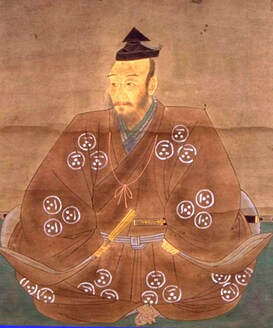
PictureMori Motonari

(The following translation is taken from Owada Tetsuo’s “Mōri Motonari – The strategy and tactics of a master general”, published by Mikasa Shobō in 2013. The book is a general introduction to the character of Mōri Motonari, considered one of the most influential rulers during the era of the Warring States and who had a profound impact on those daimyō and jitō families located in Aki and Nagato provinces (what would eventually be known as Chōshū).  The extract below, from the introduction to the book, is an exploration of the genealogy of the Mōri and how they came to occupy the lands from which they would earn their fame. The numbers in parenthesis after paragraphs refers to the location of the information in the Kindle version of the book). 
 
Chapter One
 
Motonari in his youth, and the limits of endurance
 
Birth of the Mōri clan - the founding period of the Kamakura Bakufu
 
The Mōri clan traces its origins to Ōe Hiromoto, a retainer of merit who emerged during the formative period of the Kamakura Bakufu. Following receipt of an invitation extended by Minamoto no Yoritomo, Ōe travelled from Kyoto to Kamakura in the 1st year of Ganreki (1184). He was appointed as the head of the Kumonjō (which later became known as the Mandokoro, in other words the centre for the administration of the Bakufu), and served as an aide to Yoritomo, later being assigned to positions such as shugo and jitō (both of which in the Kamakura era referred to retainers granted estates originally belonging to aristocratic families, and overseers of those estates). 
 
Such was the value of Ōe’s service that he was granted the territory of Mōri-no-shō (毛利荘) in Sagami province, Shimazue-no-shō (島末荘) in Suō province (now known as Tōwa-chō, in Ōshima-gun, Yamaguchi Prefecture), Yamamoto-no-shō (山本荘) in Higo province (Uekimachi, Kamoto-gun, Kumamoto Prefecture, now part of Kumamoto City), and Kuruma-no-shō (栗真荘) in Ise province (now Shiroko, Suzuka City, Mie Prefecture). 
 
The Ōe clan had served generations of emperors as imperial tutors (jidoku), fulfilling their role at court as instructors in letters and literature in the same manner as the Sugawara clan.  Yet it was Hiromoto’s generation who first underwent the transition from ‘tutor’ to ‘retainer’.  Hiromoto had six sons and five daughters. His eldest son, Chikahiro, was adopted into the household of Kuga Michichika, Minister of the Interior (naidaijin), while his second son Tokihiro and third son Masahiro adopted the surnames of the Nagai clan and Nawa clan respectively. His fourth son, Suemitsu, took the surname Mōri, while his fifth son Tadanari took the surname Kaitō. His sixth son entered the priesthood. (Loc.303)  
 
So, the surname Mōri finally made an appearance. Its origins lay in the name of the Mōri-no-shō (毛利荘) in Sagami province, bestowed by Ōe Hiromoto upon his family. In other words, as a consequence of the division of inheritance among Hiromoto’s various offspring, the fourth son of the family, Suemitsu, took up residence in the above area and adopted the shōen’s name as his own. (Loc.334)
 
The Mōri-no-shō from which the Mōri clan took its name is believed to extend from the northern part of Atsugi City in Kanagawa Prefecture, all the way through to the southwest of Aikawa-machi in Aikō-gun in the same prefecture.   It is important to note, however, that one shouldn’t read the name ‘Mōri-no-shō’ with the lengthened vowel, but should instead read it as ‘Mori-no-shō’. This is because in some documents from the period, the character for ‘woods’ (森, mori) is used (thereby giving an indication of how the title was pronounced).
 
No historical documents survive that explain when the Mori-no-shō was founded,  however in the “Sonbi Bunmyaku” and volume three of the “Heiji Monogatari”,  there is a record that the Mori-no-shō in Sagami province was ruled by Minamoto no Yoshitaka, the younger brother of Minamoto no Tameyoshi. We know that Yoshitaka was referred to as the ‘ruler of Mori’, and so it appears that the it had been established as a shōen around the end of the Heian period. (Loc. 334)
 
Minamoto no Yoritomo is entertained at Mori-no-shō
 
Furthermore, it appears that there was another lineage who bore the name Mōri separate to that of Mōri Suemitsu at Mori-no-shō.  The existence of a warrior retainer who went by the name of Mōri Kageyuki has been confirmed, who lived from the late Heian to the early Kamakura periods.  It’s been hypothesized that this individual might have belonged to one of the pioneer families that developed the region (Loc.334), however this theory is scant on details.  Mōri Kageyuki appears to have been affiliated with the army that Minamoto no Yoritomo took with him to attack the Taira at the Battle of Ishibashi-yama. (Loc.353)
 
The entry in the “Azuma-kagami” marked for the 18th day of the 1st month of the 1st year of Yōwa (1181) states that “At Mori-no-shō in Sagami province there is a tale a monk who resided there and went by the name of Inkei”. This makes it clear that a monk known as Inkei lived at the shōen, and is believed to have been a member of the family of Mōri Kageyuki mentioned earlier. The use of the title “Mori-no-shō” in this manner also reveals that it had already been established by the time the entry was made. (Loc.353)
 
As we continue to read the “Azuma-kagami”, we learn that the Mori-no-shō was divided into an upper and lower half.  For example, when we examine the entry for the 8th day of the 8th month of the 5th year of Genkyū (1194), it reads “it is said that Inaba Zenji…received guests in lower Mori-no-shō”. In other words, what this tells us is that Inaba Zenji, otherwise known as Ōe Hiromoto, played host to Minamoto no Yoritomo.  The same entry records that on that day, Yoritomo made a pilgrimage to Hinata Yakushi. While on the way there, he dropped by the residence of Ōe Hiromoto in lower Mori-no-shō and received Ōe’s hospitality.
 
Now, even though it is said that the shōen had been divided into upper and lower sections, there is no mention in either any literature or records, starting with the “Azuma-kagami”, of an upper Mori-no-shō. Also, it is said that the remains of Mōri Suemitsu’s residence are located at Iiyama in Atsugi City, which would put it in the middle of Mori-no-shō. (Loc.353)
 
Were the Mōri descended from the Imperial family?
 
Although Mōri Suemitsu became a member of the Council of State (hyōjōshū) from the 1st year of Tenpuku (1233), before this time, in the period from the 6th year of Kenpo (1218) to the 3rd year of Shōkyū (1221), he became a member of the priesthood at Chōrakuji after meeting Ryūkan (a renowned priest of the late Heian – early Kamakura period), adopting the priestly name of ‘Saia’.  In the 1st month of the 1st year of Hōji (1247), the same year as the Battle of Hōji (which will be discussed later), an inscription was made on the base of a statue of Prince Shōtoku kept by the temple of Tenshūji (located in modern Gyōda City in Saitama Prefecture). The inscription reads “Offered by the venerable Saia”. This is the same ‘Saia’ as referred to above, - i.e., Mōri Suemitsu. (Loc.378)
 
Furthermore, Ryūkan was invited to the Mōri estate belonging to Suemitsu and spent his final years there, passing away at Iiyama on the Mōri estate.  The remains of that residence became the foundation for the temple of Kōfukuji at Iiyama. As such, we can suppose that Iiyama in Atsugi City served as the site for Mōri Suemitsu’s residence. (Loc.378)
 
While we have revealed most of the details of the origins of the Mōri clan, one further point remains to be clarified.  That concerns what came before the appearance of Ōe Hiromoto (Loc.378). 
 
When we examine the Mōri clan genealogy, we find that it claims Ame-no-hohi-mikoto (a god of Japanese mythology) as its founder. Part way through this genealogy, after claiming descent from Nomi-no-Sukune (regarded as the father of Sumo wrestling) and Ōe no Otondo (a courtier and Confucian scholar of the Heian period), it arrives at the famous Ōe Masafusa (a famed poet, scholar, and tutor to emperors Shirakawa, Horikawa and Toba). Hiromoto is allocated the position of grandson of Masafusa. (Loc.404)
 
However, the “Genealogy of the Ōe clan” in the 7th volume of the “Zoku Gunsho Ruijū” claims that the Emperor Heizei founded the family, thus confirming a clear difference with other theories. In truth, even the genealogy that Mōri Motonari himself wrote had notes of caution, stating “the grandchild of Emperor Heizei was the son of Prince Abo Shinnō” and that “25 generations have passed from Emperor Heizei to Motonari”. In other words, the Mōri had become separated from the Imperial family. However, if we pursue the theory that the line of the descent came from the Emperor Heizei, then the explanation for the clan name Ōe vanishes into thin air.
 
In the 1st year of Meiji (1868), scholars Kondō Yoshiki and Kondō Kiyoshi made a submission to the Mōri clan, which determined that Ame-no-hohi-mikoto was the founder of the family, thereby giving it a divine genealogy.  Despite this, the theory of descent from Abo Shinnō could not be dismissed, leading to a division of usage which established that ‘the lineage comes from the gods, while the bloodline comes from the Emperor.” (Loc. 404)
 
The Mōri enter Yoshida-no-shō in Aki province

So how was it that a noble family like the Mōri, that grew and developed in the Kantō region, came to plant themselves in Aki province (in the far west of Japan)? One of the main reasons is thought to have been the “Battle of Hōji” that broke out in the 1st year of Hōji (1247). According to records, a leading figure within the Kamakura Bakufu, Miura Yasumura, got into an argument with the Shikken Hōjō Tokiyori, thereby transforming Kamakura into a battleground.  Miura was defeated, and the conflict was later regarded as the catalyst for the monopoly that the Hōjō would hold over the office of Shikken. (Loc. 420)
 
At the time, the household of the Mōri was under the control of Suemitsu.  Suemitsu’s wife was the daughter of Miura Yoshimura, aka Yasumura’s younger sister. This particular point would prove crucial in what was to follow.
 
When he learned that Yasumura was engaged in conflict against Hōjō Tokiyori, Suemitsu joined Yasumura’s army without hesitation. Nevertheless, at the battle on the 4th of the 6th month, Suemitsu was beaten and fled to the sanctuary of the temple of Hokedō (法華堂). In the aftermath of the battle, Suemitsu’s eldest son, Hiromitsu, his second son Mitsumasa (also styled Jirō Kurabito Nyūdō), and his third son, Yasumitsu were all forced to commit ritual suicide.
 
Suemitsu had one son left by the name of Tsunemitsu. At the time of the Battle of Hōji, he was in residence at Sakyo (Sahashi)-no-shō in Echigo province (Kariwa-gun, Niigata Prefecture), and so had nothing to do with Yasumura’s uprising. Hōjō Tokiyori chose not to exact revenge on him, and so settled for appointing him as the steward (jitō) to Yoshida-no-shō in Aki province. However Mori-no-shō was still confiscated by Tokiyori.
 
Ordinarily, because of his involvement in Yasumura’s revolt, all of Suemitsu’s property and holdings would have been seized by the Shikken. Possibly out of a sense of guilt for having eliminated so many influential retainers on his own side, the punishment due for Tsunemitsu was set aside by Tokiyori. In the end, this decision ensured the continuation of the Mōri clan. (Loc.420)    
 
Unfortunately there is no information available that tells us when and under what circumstances Suemitsu was granted either Sahashi-no-shō in Echigo and Yoshida-no-shō in Aki.  It may be that in relation to Sahashi-no-shō, this was inherited from Hiromoto, however as for Yoshida-no-shō, it may have been given as a reward for Suemitsu’s involvement in the Jōkyū War.  At any rate, Tsunemitsu later divided Sahashi-no-shō into its northern and southern parts, with everything south of the Nagatori River becoming Minami-jō shō, and everything north of the same river becoming Kita-jō shō. (Loc.439) The division of property by inheritance continued under Tsunemitsu, with his eldest son Motochika inheriting the property of Kita-jō shō, while his fourth son Tokichika inherited Minami-jō shō. Indeed, Tokichika managed to gain possession of both Minami-jō shō and Yoshida-no-shō. This occurred around the 15th day of the 7th month of the 7th year of Bunei (1270).  (Loc.439)   
 
Having inherited both properties, Tokichika found himself appointed as a member of the Hyōteishū, one of the highest councils of the Kamakura Bakufu located at Rokuhara in Kyoto.  In order to pay for his upkeep while resident in the capital, the Bakufu granted Tokichika the property of Kagata (加賀田) in Kawachi province (now part of Kawachi-Nagano City in Osaka Prefecture).  Minami-jō shō had a production rate of 2000 kan, while Yoshida-no-shō produced 1000 kan.  Kagata added another 200 kan to this. In the 4th year of Einin (1296), Yoshida-no-shō was divided up, with the southern part at Toyoshima and Takehara going to a resident pioneer family (the Kazanin), while the northern half of Yoshida and Asahara remained under the control of the jitō (the Mōri themselves).
 
Tokichika bore witness to many pivotal events in Japanese history, from the downfall of the Kamakura Bakufu, the establishment of the Kenmu Imperial government, through to the founding of the Muromachi Bakufu by Ashikaga Takauji. He eventually gave Kagata to his eldest son Sadachika, while Minami-jō shō was divided up between his second son Chikamoto (who subsequently gave it to his son Iechika), as well as his third son Hiroaki and Sadachika’s son Chikahira. Tokichika himself also placed the son of Chikahira, Motoharu, in residence at Yamada village in Yoshida-gō, which was part of Yoshida-no-shō (now part of Kamiobara, Kōda-chō, Hiroshima Prefecture). All this took place in the 7th month of the 1st year of Engen (1336), immediately after the defeat of Kusonoki Masashige by Ashikaga Takauji at the battle of Minato-gawa (Minato River). (Loc.462)    
 
Tokichika retained overall control of Yoshida-no-shō, which consisted of 4 gō (sub-divisions) named Yoshida-gō, Asahara-gō, Toyoshima-gō, and Takehara-gō.  His main residence (or fortress) was not at Kōriyama (which would later become the seat of power for the Mōri) but instead was located at the peak of Tōnanroku, to the south-east of Kōriyama. The Mōri at the time focused their attention on Yoshida-no-shō, and endeavoured to unite its scattered parts under one rule. (Loc.262)
The Principles of Ikki

19/8/2021

 
PictureSource: Kotobank. Voyage Marketing
Goza Yuichi, ‘The Principles of Ikki’ (Ikki no Genri), Chikuma Gakugei Bunkõ, 2017, 3rd edition
 
Introduction – Was ikki (translators note: a revolt or uprising) an anti-establishment movement?
 
Towards an age of uncertainty ‘post 3.11’
 
The unprecedented disaster that struck Japan in 2011 proved to be an opportunity for us to reconnect with the long-forgotten value of relationships.  Words such as ‘relationships’ and ‘bonds’ were used with such frequency following the disaster that issues that until recently had occupied society, such as people dying alone and the ‘disconnected society’, seemed like they had been concocted out of thin air (of course, all that had happened is that reporting about the issues had decreased, not that they had actually improved).  These words continue to be put to good use. (13)
 
When your average person hears words like ‘relationships’ and ‘bonds’, the first thing that probably comes to mind are relations with family.  Immediately after the disaster, there were many people who sought out family members, desperate to know whether they were safe and using every means imaginable to get in contact with them.  Among my friends, some took their parents in to live with them after their family home was swept away by the tsunami.  And post-disaster, the number of people who decided to tie their nuptials increased, leading to the term ‘disaster wedding’ (shinsai kon). (14)
 
In addition, households in which three generations live under one roof (an aspect of which contains strong expectations regarding economic and child-rearing support), which had (according to 2010 statistics) fallen to just 7% of all households, started to show signs of a recovery, particularly in cities.  Of course, in modern society, where the make-up of the family continues to diversify, it would be difficult from a practical point of view to bring about a revival of large families.  For people who have left their home town to move to the city, if they then decide to live with their parents, they either have to bring their parents to the city or they have to give up their job in order to return to their hometown. And then there are housewives who don’t need to hear that “no matter how violent your husband is, you mustn’t divorce him, if only for the sake of the children”. (14)
 
While there has been a boom in recent years in nostalgia for the Shõwa era, specifically ‘the Shõwa era in which a family, although poor, leaned on one another and happily lived together’ (which contains a considerable amount of romanticisation), you can’t turn back the clock, and there are limits to the safety net of relying on relations with family members.(14)
 
In fact, one of the largest problems that modern society faces are those people who have slipped through the cracks of the pre-existing arrangement between families and businesses and who find it difficult to cope.  Given that the Japanese taxation and social welfare systems were created for the ‘husband works full time as a company employee, wife remains at home with two kids’ model - in other words ‘the happily married couple’ - those who fall outside of this model, such as households where both parents work, or where there is only one parent or where a parent is a temporary labourer, experience great social disadvantage. (14-15) And knowing what might befall them should they happen to slip up, there has been a trend in couples who fear any issues that might arise between them and so allow their relationship to atrophy (in the case of company employees, they might throw away any of their own ambitions or ideas and become entirely subservient to the company, so much so that they apparently live on company grounds).(15)
 
With non-permanent employment on the rise in today’s society, anyone who lives as a ‘full time housewife’ or ‘full time employee’ might be regarded as a ‘winner’. Yet given that this means that you must hang on for dear life no matter how dreadful either a family situation or workplace happens to be, these ‘winners’ are actually in a ‘prison’ where happiness is in limited supply (while the Japanese economy was growing, these problems remained hidden beneath the surface). (15). 
 
The new ‘medieval era’ present in modern society
 
Some of the more elderly ‘intellectuals’ in Japan may have forgotten that in Japan’s post-war democracy, ties of ‘blood’ and ties to ‘land’ were regarded in a negative light.  Recently a young essayist by the name of Furuichi Noritoshi made an astonishing literary debut by pointing out that these ties proved an impediment to the development of the ‘modern individual’ and criticised them as antiquated ‘restraints’. (15)
 
In my specialist field of medieval Japanese studies (particularly the research conducted by Katsumata Shizuo and Amino Yoshihiko), ‘unrelated’ (muen, or ‘without ties’) as a concept carries a positive meaning (as discussed later) and is not distinct to the development of the modern intellectual and his or her progressive ideas. (16) Indeed, I do think that it is quite indulgent for people to say “the best course of action is for family members to rely on one another” when disaster strikes.  
 
Following the Great East Japan Earthquake, many young people made a beeline from across the country to the disaster zone to serve as volunteers.  According to Furuichi, the earliest responders to the disaster and those who took a leading role in their volunteer work were members of foreign volunteer organisations who had experience delivering aid to developing countries such as Cambodia and Bangladesh.  (16)
 
While claiming that “Japan is one”, for these volunteers, ‘the Great East Japan Earthquake’ and ‘Cambodia’ were inter-changeable as events that required their assistance.  Their motivation for taking the lead in heading for the disaster area was not a result of nationalism emanating from an idea that ‘we’re all Japanese’.  Rather it was because they felt sympathy for ‘others’. (16) Now while it might seem a bit cold-hearted to refer to the people of the Tohoku region as ‘others’, consider how tolerable were people who, even though they weren’t directly affected by the disaster, self-indulgently pontificated with a know-it-all expression about their ‘belief in the strength of Japan’ and ‘how Japan will definitely recover’? Rather than relying on an overly sentimental identification with ‘Japan’, it is only by squarely confronting the cold reality of the very different circumstances that these people are under compared to those people in the disaster zone can new bonds be formed and true recovery assistance commence. (16-17)
​
Together with the march of globalisation, modern society, in which modern order as defined by the sovereign state is becoming increasingly relative, is gradually being referred to as a ‘new medieval era’.  Indeed, the idea of overcoming adversity through the creation of new networks rather than relying on the return of communal organisations is the same idea behind the ikki of the medieval period. (17)
 
The post-war historical view of ‘Ikki’
 
And yet ‘ikki’ has an almost inseparable association with revolutionary imagery.  When a continuous series of revolutions occurred throughout the Arab world from 2010 to 2011 (afterwards referred to as the ‘Arab Spring’), something that caught my eye were comments on the internet saying “they are like the ‘ikki’ found in Japanese history”, thereby revealing an association of anti-government people’s movements with ‘ikki’.  (17)
 
In 1917, women from a coastal town in Toyama Prefecture led protests against the monopolisation of rice by local rice merchants and land owners and the unreasonable price at which rice was being sold. This event, subsequently known as the ‘rice riot’ (kome sõdõ) was referred to by papers at the time as the ‘Etchû(translator’s note: former name for Toyama) women’s ikki’.  The security protests that took place in the 1960s were also regarded as ikki.  (17). The Nobel literature prize awardee Oe Kenzaburõ, in his novel titled “The Silent Cry” (published in 1967) combined the peasant ikki of 1860 (the first year of Manen) with the protest over the security treaty in 1960 (Shõwa 35). (18)
 
This problem is not merely confined to how the general population regards the phenomenon of ikki.  Even specialists in Japanese history more or less treat ‘ikki’ as revolutionary movements.  All 5 volumes of the series ‘Ikki’ published by the University of Tokyo in 1961, and which still serve as the foundation for most studies on ikki, describe ikki in their preamble as a ‘fixed form of pre-modern class struggle’. 
 
Class struggle is one of the key concepts of communism. Simply put, it envisages that in a society made up of classes, the non-ruling class will struggle against the ruling class in order to prevent being exploited.  In more modern parlance, you might say that it is an anti-establishment, anti-ruling power resistance movement.  In its most extreme form, the non-ruling class refuses to abide by the system established by the ruling class and overturns it in a ‘revolution’.  The ‘Communist Manifesto’ published by Karl Marx and Friedrich Engels in 1848 declared that “all history is the history of class struggle”.  Class struggle thus occurs over and over again, and every time it does society is reformed and advances.  Once the non-industrialist class ‘the proletariat’ seizes political power (the proletariat revolution), the history of class struggle comes to an end and the communist society becomes a reality.  This is the ‘class struggle view of history’ that Marx espoused. (18)
 
So should we regard the ikki of the Sengoku and Edo periods as examples of ‘class struggle’? It does seem as though the dreams and ambitions of postwar historians were reflected onto ikki.  Communism gained popularity in postwar Japan in the period of reflection that followed the age of militarism.  In historical study circles, ‘Marxist history’ rose to the fore.  These historians regarded communism as the pinnacle of social development and held hopes that a communist revolution might take place in Japan as well. (19) 
 
As a result, the ‘history of the Japanese people’s struggle against authority’ became a major theme in postwar historicism.  This trend then led the history of ikki to be studied from the point of view of the ‘history of class struggle’.  It’s because these historians thought ‘we’re fighting for the revolution too!’.  Despite the collapse of the Soviet Union and the end to the dream of revolution, this historical bent, after undergoing a little bit of revision, continues to this day. (19)
 
Ikki was ‘a link between people’
 
As will be detailed in this book, in reality ikki was not a struggle over authority or power.  To put it more bluntly, the insistence that the ikki of the pre-modern era were examples of class struggle has not basis in fact and were fantasies concocted by postwar Japanese historians.  In other words, it something that they wanted to believe was true. Rather than thinking of them as either violent demonstrations or revolutions, it would be more realistic to consider ikki as one pattern of relationships between people. (19-20)
 
Moreover, the student and union movements of the 1960s did not burn with high-minded ideological fervor, and the fact that they were festival-like in manner speaks to the popularity of ‘utagoe-kissa’ (or coffee shops where one could sing tunes) at the time. Of course, I’m not saying that the participation of folks who indulged in a bit of fun was in any way pointless or ridiculous.  If they wanted to belt out tunes so much the better.  What I’m saying is rather than trying to deify only those directly involved in trying to bring about revolution, one should also cast an eye over all of the inter-personal relations that form the basis of a political movement. (20)
 
When one accepts that ikki was not a ‘class struggle’ but a social network, one ceases to think of ikki as simply “something that happened a long time ago”.  The study of ikki thus becomes directly relevant to modern society.  This book takes that view as a starting point when considering the role of ikki in Japanese history.  What I hope to offer is a new way of examining modern society where relations between people often undergo radical transformation. (20)


Akusō and the temple complex of Enryakuji

19/4/2015

 
Picturekyoto-brand.com
This week I’m going to go back to a pet favourite activity of mine and provide another translation of a chapter from a book I am reading at the moment called Sōhei= Inori to Bōryoku no Chikara (Warrior Monks – The Power of Prayer and Violence) by Kinugawa Satoshi (Kodansha, 2010). For any readers of this blog who are interested in getting a much more in depth run down of the function of warrior monks in medieval Japanese temples, Mikael Adolphson’s Teeth and Claws of the Buddha is the most authoritative study of Sōhei and their function in medieval society available in English. What follows here is a mere slice of a much larger topic that has been well covered by Japanese historians for the best part of a century.  

There are still studies, however, that pop up from time to time that provide a new perspective on the whole phenomenon of religiously sanctioned violence and its effect on society. The chapter that follows is from just such a study.

The mountain peak battle of Chōji

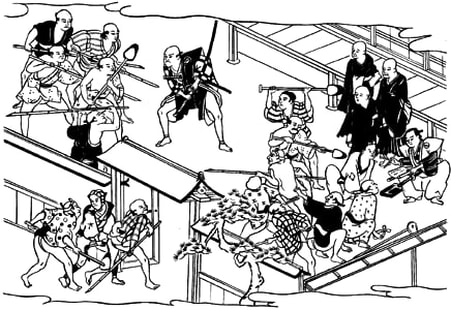
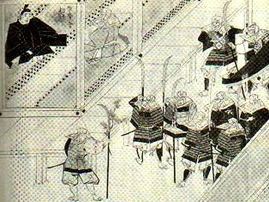
In the latter part of the Heian period at the head temple of the Tendai sect of Buddhism, Hieizan Enryakuji, internal factional battles regularly broke out which were accompanied by the appearance of armed temple followers. These were the so-called “Sōhei” (literally, warrior monks), and were widely regarded as a symbol of the destruction of the ‘Buddhist Law’ (Buppō) that characterised this period. At the same time, and in the same way, the temple of Kōfukuji located in Nara also had its own Sōhei , and these two major temples exercised a powerful influence over the religious world of their time (this division in power between Enryakuji and Kōfukuji was known as the Nanto Hokurei, or 南都北嶺). (p.16)

As an introduction to this subject, I will pay attention to an incident that took place in the 1st year of Chōji (1104) which is a typical example of the type of internal conflict witnessed at Enryakuji during the Heian period.  Enryakuji comprised a large number of estates that spanned across the Mt Hiei area. The three principle estates of Enryakuji were known as Tōdō (the Eastern Tower), Saitō (the Western Tower), and Yokawa.  The estates were not determined by geography, but functioned more as a political entity in which meetings known as Shūe took place. In order to preserve their territory and right to use the labour found therein, each ‘tower’ maintained an independent political stance and acted in their own interests. The temple complex of Enryakuji, which comprised these three towers, was certainly not monolithic. (p.16)

 The incident of violence detailed here occurred as a result of a clash between the Eastern and Western towers.  The incident itself reveals in stark detail the type of armed conflict undertaken by monks in temple complexes at the time, and clarifies the role played by groups of monks (known as a Daishu) and their ties to ‘Akusō’ (literally, evil monks, 悪僧), a term often used at the time to describe such characters.(p.16)

In the 7th month of the 5th year of Kōwa (1103), Fujiwara no Tadazane, the Minister of the Right to the Imperial Court, issued an expulsion order against the monks of the Western tower of Enryakuji (this information is derived from the Denryaku, a diary maintained by Tadazane dated for the 22nd day of the 7th month).  The Daishu of the Western tower was spurred into taking action against Tadazane, although the actual course of action is unclear. From the 3rd month of the following year, diary entries reveal the increase in sporadic fighting between the Eastern and Western towers. It did appear to Tadazane that the age of the downfall of the Buddhist Law had arrived, given the prevalence of acts of arson and the destruction of monk lodgings by either faction. It is certainly likely that Tadazane’s expulsion order of the previous year played a role in sparking the feud between both towers. (p.16-17)

While this was going on, the background story to the conflict between the towers began to reveal itself. In the 6th month of the 1st year of Chōji, a “Daishu” submitted a formal request to the Court that Gon no Shō Sōzu Jōjin (貞尋) be punished by being sentenced to exile from the temple complex (it is not clear at this point to which Daishu the diary was referring). The Daishu fingered Jōjin as being both a conspirator and agitator in the recent disturbances between the towers. When Jōjin managed to escape punishment despite confirmation of his guilt, mainly as a result of Court largess towards Jōjin, the Daishu continued to demand that he be punished. (p.17)

At the same time, the Daishu charged that a monk known as Keichō (慶朝), who at the time was the head of the Tendai sect, was in cahoots with “that evil monk Jōjin” and retaliated by destroying Keichō’s living quarters.  Keichō was a monk affiliated with the Yokawa tower, and fulfilled a dual role (in addition to being head of the sect) as administrator of Yokawa’s territory. On the other hand, Jōjin, Keichō’s co-‘conspirator’, was affiliated with the Western tower.  Since, as a result of the request, Jōjin was denounced and Keichō had his quarters demolished, the Daishu referred to above was not that of the Yokawa or Western towers but was from the Eastern tower. The conflict from the previous year between the Eastern and Western towers had thus spread to the Yokawa tower and intensified. (pp.17-18)

An attack on the head of the sect was obviously a problem for the Court, so in the 10th month the Court ordered that a Sōgō (僧綱) be convened in order to investigate the incident. A Sōgō was a meeting of various officials that transcended sect divisions and whose function was to regulate and administer the activities of monks and nuns. Whenever a problem emerged between monks, the Court took it upon itself to convene a Sōgō. Diary entries of the time note that the Sōgō would be ordered to clarify whether the disturbance affected the overall structure of Enryakuji or whether it was the result of the actions of a limited number of individuals. If the disturbance resulted in recourse to arms, the Sōgō was also authorised to dispatch warriors to the entrance to the mountain temple complex at Sakamoto (in modern Shiga prefecture). (p.18)

Unfortunately no historical records remain that explain how this particular disturbance was resolved.  However, from the 12th month of the same year (Chōji 1) through to the 1st month of Chōji 2 (1105) a new disturbance broke out between Enryakuji and the temple complex of Onjōji (Miidera). This new conflict obviously demanded Enryakuji’s full attention, and so it appears that the internal conflict between the Eastern and Western towers was resolved before tackling the feud with Onjōji. As Keichō resigned from the position as sect head in the 2nd month of Chōji 2, we can surmise that he took responsibility for bringing the internal dispute to an end and withdrew.(p.18)

This particular disturbance, which is referred to in the Chūyuki diary as the ‘mountain peak war’, features a range of individual monks apart from those already referred to here. There are certainly many who considered these monks to be typical examples of “Akusō”. As revealed at the beginning of this chapter, these individuals, whose existence within the temple complexes of medieval Japan was so entwined with violence, certainly garner our interest as Sōhei.

However the fact that these individuals were referred to as “Akusō” does not mean that diarists simply assigned to them a pejorative nuance that stemmed from an act of violence. In many instances, the actions undertaken by these individuals were sanctioned by their Daishu.  In order to ensure that one does not come to conclude that Akusō were by nature outlaws, it is necessary to outline their relationship to the Daishu. This chapter will explore the various theories that have emerged regarding the “Akusō” that appear in the “mountain peak war”, and will explore the peculiarities of the age that gave rise to such figures. (pp.18-19)


From the Yomiuri Shimbun - Who is the person depicted in the portrait of `Minamoto no Yoritomo` held by Jingoji temple?...A new study casts a spanner into the works...

9/9/2012

 
This particular article came up during the week in the literature section of the Yomiuri Shimbun (J) for Tuesday, the 4th of September. The content was quite interesting, so I thought I`d provide a translation of it below.

"The portraits of three figures (designated as national treasures) held by Jingoji temple in Kyoto have long been thought to depict the founder of the Kamakura Bakufunate, Minamoto no Yoritomo, Taira no Kiyomori`s son Shigemori, and an aristocrat of the late Heian period, Fujiwara no Mitsuyoshi. However, debate about the true identity of the figures in the portraits has continued ever since the art historian Yonekura Michio declared in 1995 that the portrait of Shigemori was in fact the founder of the Muromachi Bakufunate Ashikaga Takauji, that of Yorimoto was Takauji`s younger brother Tadayoshi, while that of Mitsuyoshi was in fact Takauji`s son Yoshiakira. Now a new work by Rissho University Professor Kuroda Hideo (a historic portraiture critic) titled `What are the three portraits of Jingoji?` (国宝神護寺三像とは何か) (Kadokawa Books) has cast a new stone into the debate. It follows the reasoning behind the creation of the portrait reportedly of Yoritomo from the point of view of Tadayoshi.

The portrait of Yoritomo was recently put on public display as part of a special exhibition titled `Yoritomo and Chogen` (which runs until September 17) and sponsored by the Nara National Museum. The portrait itself, which depicts a figure in courtly dress and exudes grandeur, is 1.4m long by 1.1m wide, and dominates a room with its presence.

According to Jingoji temple records, there exists three portraits of three figures created by the master portrait artist of the late Heian-early Kamakura era, Fujiwara no Takanobu. The three portraits held by the temple, which are almost the same size and drawn upon a single frame of silk, are thought to be the portraits referred to in the records. However according to Professor Kuroda`s theory, the three portraits were in fact created in the 14th century, and bases this upon a historical record which says that Tadayoshi donated a portrait of himself and that of his brother Takauji to the temple in 1345. 

To further substantiate this theory, Professor Kuroda points out that upon an examination of the portraits, all three of them use silk the thickness of which was common from the 14th century onwards, and so refutes the original theory that they were works of the Kamakura period.  He also pays particular attention to a record detailing dialogue held between Tadayoshi and the Zen priest Muso Soseki (夢窓疎石) titled `the Muchu Monto Shu` (or Collection of Dialogues within a Dream).

Muso began his dialogues with Tadayoshi in order to instruct him in the canon of Buddhist law as outlined by Prince Shotoku, and spoke of a portrait that depicted both the founder of Shingon Buddhism in Japan, Kukai, together with the protective deity of the Genji clan Hachiman Daibosatsu, which was known as the `Tagai no Miei` (互いの御影) (The Shared Influence) and was housed within Jingoji temple.  Professor Kuroda says that Tadayoshi took this example, and had himself painted as Kukai, the latter manifestation of Prince Shotoku, while he had Takauji depicted as the guardian and war god Hachiman, and then donated the portraits to Jingoji as a offering to ensure the continuation of the dual nature of the Ashikaga dynasty.

As for the portrait reportedly of Mitsuyoshi, the temporary victory afforded to Tadayoshi during his conflict with Takauji during the Kanno War (1350-1352) gave him all the incentive to donate a new portrait of Yoshiakira to the temple in order to replace that of Takauji.  In the early stages of the Muromachi Bakufunate, Takauji was responsible for military matters while Tadayoshi took care of political and administrative matters. On the recommendation of Muso, Tadayoshi had affiliates of Zen temple Ankokuji built throughout the nation. Professor Kuroda theorizes that the portrait of Mitsuyoshi is inferior to the previous two portraits, reflecting the time and circumstances under which it was made.

However Professor Kuroda`s theories have been disputed by those who point out that the only direct proof that he uses to substantiate his claim is a single record. Hence the Yoritomo theory for the portraits remains strong. The exhibition in Nara also displays a portrait of Yoritomo belonging to Seifukuji of Fukuoka. Records clearly state that this portrait is that of Minamoto no Yoritomo, and was donated to Jingoji in 1698. So at the very least, this particular portrait is definitely that of Yoritomo.

Tadayoshi was eventually defeated by his elder brother and killed, yet fundamental questions still remain as to why the figures depicted in such masterworks  would be forgotten.  Professor Kuroda says that he welcomes criticism and alternate theories for the portraits, and expects that the debate will only heat up from here on in.

(Culture Bureau, Hayakawa Yasuo) 

A few thoughts on Shimizu Katsuyuki's "Daikikin, Muromachi Shakai o Osou!" Part Two

6/6/2012

 
Grave News in the Capital

Historians dealing with the period in question, that of the Muromachi era, would be very familiar with two indispensable resources that detail life at the time; the Kanmon Nikki (看聞日記) and the Mansai Jūgō Nikki (満済准后日記). It goes without saying that without these resources at hand, it would be nigh on impossible to describe what happened next with regard to events on Tsushima. The scene now shifts from Tsushima to the capital of Kyoto. The description of events that took place during the attack on Tsushima were compiled using a Korean source, the “True Record of the Kingdom of Chôsen” (朝鮮王朝実録), however in order to appreciate how news of the clash on Tsushima was received in the capital, we shall now rely on the descriptions provided by the above diaries. (17)

To begin with, we shall take a look at the Mansai Jūgō Nikki. This diary was written by the monk Mansai (満済) of the Sanbōin of Daigoji temple (醍醐寺) (1378 – 1435), located just to the south of the capital. At the time Mansai was 42 years old. He served as a guardian and tutor to three generations of shogun to the Muromachi Bakufu, namely Yoshimitsu, Yoshimochi, and Yoshinori. In his later years he would assume responsibility for resolving matters of state, and would become known as the “Chancellor in Black” (黒衣の宰相). His diary, when compared to the Kanmon Nikki, is more curt and restrained in length and tone, yet without it we would have no way of knowing the type of secret information available to the Bakufu or possess such information in abundance. Hence the historical value of this diary is second to none in contributing to our understanding of the political history of the Muromachi Bakufu. (18)

On the 7th day of the 8th month, roughly one month after the events in Tsushima, a letter arrived at the Bakufu Gosho (御所) addressed to Mansai from Shoni Mitsusada (少弐満貞) of Kyushu detailing the incident. Mansai’s diary contains some rather surprising quotes taken from Mitsusada’s letter, the content of which deserves to be relayed in full; (18)

“A Mongol vanguard fleet of more than 500 ships made their way into the bays of Tsushima island. My vassal on the island, Sō Saemon, together with over 700 mounted warriors, rode out to meet them and engaged them in a number of battles. On the 26th day of the 6th month the fighting continued until sundown, whereupon the foreign soldiers were defeated. It is said that almost all of them were either killed or taken prisoner. Two of the foreign generals were captured, and from them we obtained a range of important information. According to the captured generals, the 500 or so vessels all belonged to the Kingdom of Korei. Some 20,000 or more Chinese vessels were meant to make landfall on Japanese soil on the 6th of the 6th month, but as a result of strong winds that appeared that day, the Chinese vessels were forced to retreat, whereupon they sank into the ocean. It appears that a number of unusual events took place during the conflict. The spirit of Sugawara no Michizane appeared, and I have heard that a number of miracles took place.” (18-19)

It is fairly obvious that by exaggerating the number of vessels sighted off the island, and referring to Saemon as being a “vassal”, Shōni Mitsusada was using this incident as a means to promote his own prowess. Furthermore, the fact that the army of Koreans was merely a vanguard, and that there was an armada of over 20,000 Chinese vessels behind them, all pointed towards this being a plan conceived by the “Mongols” to suppress Japan, despite the complete lack of evidence to reinforce such a view. The fact that the invasion fleet had been defeated by a combination of “strong winds” and the ghost of Sugawara no Michizane was little more than an exaggeration to reinforce the Kamakura era image of these “foreign pirates”. (19)

Memories of the Mongol Invasions

Nearly 150 years had passed since the Mongol Empire had twice attempted to invade Japan. What is more, the Yuan dynasty that had spurred the invasion had disappeared a half century before the events at Tsushima. Nonetheless, the news that arrived at the heart of the Muromachi Bakufu a month after the invasion had referred to it as an attack by the “Mongols”. For Mansai, who had received the news, he appeared to have been inclined to believe it in full. In his diary he recorded his thoughts, which were quite innocent in their praise…”Though much is unknown this cannot be ignored. I have heard that in shrines across the country, various miracles preceded these events. Is this not indeed wonderful?” (20)

It would not have been impossible for someone like Mansai to accept the content of the letter from the Shōni as the truth. At the time, reports were that a number of unusual “sightings” had been made at shrines throughout the capital.  Mansai’s diary notes that on the 6th of the 6th month, “irregularities” had taken place at the Great Shrine at Izumo (出雲大社) and Kamo shrine (賀茂神社) in the capital. “Shaking” had been felt at the Nangū shrine in Mino province, while there had been landslides at Kibune shrine (貴船神社) in Kyoto, among other odd events. On the 2nd day of the 7th month, Mansai himself had prayed for the “defeat of the foreigners” (異国調伏). On the 19th day of the same month, Mansai heard of a young girl at the Atsuda shrine in Owari province becoming an oracle of the gods, all of whom had assembled from Ise and Hachiman shrines in front of Atsuda shrine in order to give notice on how to defend against the “coming of the foreigners”. (20)

Even since the attempted invasion by the Mongols during the Kamakura era, medieval society, when confronted with the possibility of war with foreign powers, restored lands that had previously belonged to shrines and rebuilt shrine buildings in order to encourage the gods to recover their divine power. The shrines at the time would insist on their “divinity” and “irregular occurrences” in order to win further concessions from both the Bakufu and the court, so much so that across the nation suddenly shrines were sending reports of “strange events” that had taken place within their grounds. For shrines, which had access to this information far earlier than any other entity, such events provided an opportunity for them to expand their authority. Hence by the time the letter from the Shōni arrived in Mansai’s hands, the streets of the capital were rife with unsettling news that the religious institutions were doing their best to either exaggerate or encourage. (21)   

The very abruptness of the use of the name “Mongol” may seem somewhat out of place to us, however to the people at the time it was very much a relevant term. Nowadays we can easily refer to a timeline which will tell us that the Mongols attempted two invasions of Japan, one in Bunei 11 (文永十一年,  or 1274) and another in Kōan 4 (弘安四年, or 1281), yet Kublai Khan was believed to have never abandoned plans for a third attempt at conquering Japan. In order to meet this potential threat, the Kamakura Bakufu embarked on a program to strengthen the coastal defences and maintained a strict vigilance with regard to foreign threats, a stance that lasted until the downfall of the Bakufu.   Even after the disappearance of the Bakufu, rumours circulated within Japan from time to time of a Mongol attack on Japan. (21)

The establishment of the Muromachi Bakufu did not put an end to such rumours, for in the 5th month of the 1st year of Ōan (応安元年, or 1368), the Goku Maiki (後愚昧記) records just such a story. In the 3rd month of the 4th year of Bunan (文安四年, or 1447), the Kennai Ki (建内記) confirms yet another rumour of a Mongol attack. Even the Kamakura Kubō, located in the east of the country, feared a return of the Mongols. On the 3rd day of the 3rd month of every year, at Yuigahama in the town of Kamakura, a dog hunting festival was held in order to pray for an expulsion of the Mongols (蒙古退治の御祈禱). What this shows is that even for the people of the Muromachi era, the memory of the Mongols was still fresh. Even without the benefit of a timeline, the image of the Mongols had not vanished, and that there still existed a fear among the Japanese that the Mongols were merely waiting for an opportunity to launch another attack on Japan.  (22)

Even now, the phrase “mukori kokuri – ムコリコクリ, which is derived from the Japanese words for Mongol, ‘Mōko’ (蒙古) and Korean, ‘Kokurei’ (高句麗)” refers to something whose true nature is unknown. This phrase, which originated in western Japan, is now used across the nation. In the novel “Black Rain” written by Ibuse Masuji, the people of Hiroshima, upon seeing the unusual mushroom cloud created by an atomic bomb, refer to it as the “mukori kokuri cloud”. Such was the trauma created by the Mongol invasions during the Kamakura era that its legacy echoed on down the ages in language that reflected such fear. (22)

A few thoughts on Shimizu Katsuyuki's "Daikikin, Muromachi Shakai o Osou!" Part One

6/6/2012

 
As promised in my last post, I have translated part of Chapter One of Shimizu Katsuyuki's eye-opening book on medieval Japanese attitudes towards the "other" and those mechanisms that were employed to try to cope with natural disaster. At present, I'm only planning to cover the first part of the chapter, which I will divide into two parts (otherwise this will be an extremely long post!).  Incidentally, the numbers in parenthesis refers to page numbers. Enjoy at your leisure.

Chapter One:  The Mongols are coming!

An island on a volatile border

This particular tale occurred one year before the outbreak of the great famine of Ōei. At the time, the island of Tsushima (対馬, now Tsushima City, part of Nagasaki Prefecture) functioned as a sort of ‘gateway to the west’, linking together both northern Kyushu with the Korean peninsula. Its total surface area amounted to 710 square kilometres. When one looks at a map of this large island, which unfolds gradually in both a northerly and southernly direction, one notices that it is fairly broken up in the central section, effectively dividing the island into two.  In the middle of this area, on a peninsula known as Ozaki located in Asō bay, lay a fishing village known as Tsuchiyori (土寄).  On the 20th day of the 6th month of the 26th year of Ōei (or 1419), around 10 or so ships appeared in the waters off the coast located near the village. (12)

Upon seeing the silhouette of the ships on the horizon, the villagers thought that they were friendly vessels returning to port, and so collecting up both sake wine and victuals, took these to the coast and waited for the vessels to arrive. However, it soon became clear that these vessels weren’t those of a friendly neighbour. The ten or so ships that the villagers had first seen soon grew in number, so much so that they eventually constituted an armada of 227 vessels. The vessels were heading straight towards the village, where it was obvious that they planned to make landfall. Yet who on earth did they belong to? In a panic, the villagers threw away the food they had brought with them and their belongings and scattered in the direction of the mountains behind the village. (13-14)

Fifty or so villagers decided to test their mettle and so took to their boats and headed out in the direction of the armada. Their vessels were soon reduced to matchwood by the mysterious armada, which then laid anchor off the coast and despatched smaller vessels. These vessels disgorged troops one after another, who quickly dispersed into the island’s interior. These troops seized 129 vessels belonging to the villagers, and after judging that 20 or so vessels were still suitable for use, burned the remaining boats. They also set fire to 1,939 houses belonging to the villagers, and destroyed their crops.  During the course of their attack, the invading army killed 114 villagers and took 21 hostages, and managed to occupy one section of the island. (14)

The invading army then spent the next few days crossing from Asō bay to attack the village of Kofunakoshi (小船越) which it eventually seized. In a short space of time, the invading army had become an army of occupation, managing to divide both the southern and northern parts of the island with a majority of their strength focused in Asō bay. On the 26th day of the 6th month (or the 27th day of the 7th month according to the Gregorian calendar), the invading army concentrated in troops in the Nii gun region not far from Asō bay. These troops were divided into three separate armies, with the largest heading off in the direction of the north of the island. At the time, the rulers of Tsushima island, the Sō (宗) family, were based in the north at Sakaura (佐賀浦) bay, which functioned as a de facto capital. Quite possibly the largest section of the invading army planned to march north to force Sakaura to capitulate, and consolidate their control over the island. (14)

Yet it was at this point that the native forces on Tsushima island began to resist the army of invasion. The corps of troops that constituted the left wing of the invading army was surprised by an ambush laid by the Tsushima forces, which resulted in around 110 deaths among the invasion force. This initial success has been relayed by islanders to their descendants in florid terms under the title of “the Battle of Nukadake” (糠嶽合戦). This victory became a catalyst for islander resistance to the invading army, who then set about creating a more organised defence from the interior of the island. (15) Meanwhile, the right wing of the invading army also encountered fierce resistance from islanders, so much so that the central part of the army had to forego landing at Nii gun in order to deal with the threat to its right flank. (15)

There were no further major battles between the native islanders and the invading army, who then settled into a series of small tit for tat skirmishes while moving from one part of the island to another. Eventually the Sō were able to broker a truce with the invasion force, which withdrew from Tsushima at the beginning of the 7th month. (15)

The details of the events above are an overview of an attack carried out against a border island by the vessels belonging to a foreign nation. Those who are particularly knowledgeable about history will have already correctly surmised that the incident referred to here is the “Foreign Piracy of the Ōei Period” (応永の外冦), which is an example of the type of internecine warfare that occurred in the border islands during the medieval era. The “mysterious armada” that attacked the island was no gang of lawless seafarers, but was a legitimate army organised and despatched from the Kingdom of Li on the Korean peninsula. (15)

At the time, the Korean monarchy had suffered no end of strife at the hands of gangs of pirates known as “Wakō” (倭寇) that plied the East China Sea. As such, the Li dynasty had taken it upon itself to launch an attack against what was regarded as the heart of the Wakō territories, the island of Tsushima (in Korea, the incident is known as the “Suppression of the Eastern Barbarians” or 己亥東征). The Korean army that landed on Tsushima did not simply burn down the villages on the island, but also freed 31 Chinese men and women who had been abducted by the villagers.  The viewpoint of the Korean monarchy that regarded Tsushima as a hotbed of piracy was correct, as it is difficult to argue with the fact that a lack of arable land on the island forced the islanders to conduct raids on the continent in order to steal both property and people. The leader of these pirate gangs, who controlled the straits and who was the first to suffer his house being burnt down, was the head of Tsuchiyori village, Sōda Saemon Tarō (早田左衛門太郎). (16)

Sōda, together with other prominent pirate leaders, hid their fleets in the bays and inlets in the centre of the island, and from their base at Tsuchiyori and Kofunakoshi embarked out across the East China Sea, striking terror into the hearts of the inhabitants of the mainland and the Korean peninsula.  One year before the invasion took place, the head of Tsushima island Sō Sadashige (宗貞茂) died of illness, so that at the time of the invasion the head of the island forces was the infant Tsutsu Kumamaru (later Sō Sadamori, or 宗貞盛). Given that the previous lord of Tsushima was dead and his successor not yet ready to rule, Sōda Saemon and other kokujin on the island moved to separate themselves from the control of the Sō family, and so began to engage in piracy on an hereto unforseen level. (16)

Although this invasion saw deaths in battle in the hundreds, fortunately the conflict itself lasted no more than a week, and was predominantly confined to the area around Asō bay.   As such, though it was certainty a problem to those involved, it was no different to the many other forms of regional strife that occurred across the country during the medieval period. However, to those living far away in the capital that got wind of the incident, it certainly couldn’t be treated so lightly. (17)

A few thoughts about Mikael Adolphson`s Teeth and Claws of the Buddha

24/5/2012

 
Mikael Adolphson`s The Teeth and Claws of the Buddha:Monastic Warriors and Sōhei in Japanese History, University of Hawaii Press, Hawaii, 2007.

One of the most interesting points that Adolphson makes in the introductory chapter is to reveal the nature of the debate over the use of the term sōhei. He quotes the work of many Japanese scholars on the subject, and notes that the use of the word sōhei emerged during the Tokugawa era (around 1715), and that before such times the armed members of temple complexes were known by a variety of names but never as sōhei. Despite this, Adolphson also shows that the term sōhei is so deeply ingrained in popular consciousness that it is unwittingly used by specialists in medieval studies without question, despite the fact that such usage is anachronistic (according to Adolphson, the term sōhei came by way of Korea where it was first used to describe temple monks fighting against invasions by the Jurchen).  

Another point that Adolphson illuminates has to do with the actual construction of the idea of monastic warriors. Debate on what constituted a monastic warrior has carried on for over a century, yet there have been few close studies related to searching sources for clear illustrations of armed monks. Some authors have stated that monastic warriors were retainers of aristocrats who entered the temples after taking the tonsure, others have stated that they were drawn from the lower ranks of the temple hierarchy (from the myriad of lay workers that performed various tasks around the temples), to more Marxist interpretations of conflict between the lower and upper ranks of the temple. While all of these theories might have merit, if someone is to be defined as a monk, it implies that they practiced religion. If they didn`t, they should merely be called armed retainers of major temples. Adolphson also outlines what must be something of a problem in passive reading of sources – the acceptance of terms verbatim despite their absence from primary sources, a problem evident in the work of many Japanese scholars.

The cowls worn by monks during the period in question (900 to 1400) were primarily used as a means to preserve anonymity. If a person wished to listen in on a sermon in secret, they would don a cowl. The same would go for those persons wishing to participate in ceremonies from outside the temple organization. Hence they were not, at first, overwhelmingly associated with armed monks. Moreover, it was Ryōgen who proscribed the carrying of armaments within the confines of Mt Hiei, despite the fact that he was instrumental in creation the schism between the Ennin and Enshin branches of Tendai, and expanding the authority of Enryakuji over surrounding regions.

The essential premise of Claws of the Buddha is to illustrate that there is no exclusive image of sōhei and their motives. He brings up the subject of dōshu, or commoners employed by temples for the purposes of maintenance and administration. Often these people were from a military background and certainly had familiarity with weapons (as evident in the growing militarization of society during the Kamakura era). As the records of the time speak of `evil monks` (as these records were by and large kept by imperial authorities or else by military families affiliated with the imperial system) in regard to any or all temple affiliates, Adolphson believes that many of such commoners may have acted out their frustrations with the government system at the time by using the protection of a powerful institution like the temples of Enryakuji and Kōfukuji. In this sense they would have been no different from commoners who allied themselves to military families. Therefore the figure of the sōhei may not have been one confined to the priesthood, but may rather have been a lay person acting on behalf of the temple. This idea extends to the image of sōhei in cowls with naginata at their sides – Adolphson believes that this picture is misleading as most dōshu would probably have been indistinguishable from secular warriors.

Adolphson also devotes some time to the figure of jinnin, or shrine servants. These were people who devoted themselves to the affairs of great shrines. By and large they were artisans and craftsman who made their livelihood selling items for the shrine. As they worked for a religious institution, they were exempt from taxation and could remain outside the law, which made jinnin status particularly attractive for those with a grudge against the imperial government. He provides a number of examples of jinnin inspired protests and vandalism to prove his point. Adolphson then concludes by saying that jinnin were not passive traders yet could be ambitious with some standing in society. Affiliation with a shrine could give them prestige which they could use in disputes against their foes. As Adolphson says, the jinnin were a `crucial element in the larger shrines throughout the Kamakura period`. He goes on to say that…”If the jinnin comprised a diverse group ranging from workers and administrators to local warriors, their special privileges and status made them a group with common interests primarily outside the precincts and purposes of the monastery. They not only performed their trades under a shrine`s protection, they also might and did act aggressively, and often violently, on the pretext of patron sanctions”.(from p.78)

Interesting fact in relation to the introduction of Buddhism to Japan was the fact that the Soga family, who were the principal advocates of Buddhist beliefs in Japan in the sixth century, became embroiled in conflict with other families who wanted to continue adherence to the Shintoist gods. Adolphson goes on to state that the Buddhism brought to Japan had been influenced by both Chinese and Korean traditions. As such, it inherited from those nations (particularly the Tang) a set of codes and stipulations, in essence twenty seven articles detailing the behaviour expected of clerics and codified in the Sōni ryō of 718. It forbade monks and nuns from killing, stealing, keeping and reading military manuscripts, forming criminal gangs, or receiving donations of serfs, oxen, horses, or weapons. Adolphson also makes the good point that Buddhism in Japan, like elsewhere, was never separate from the social and political reality that surrounded it. Some references can be drawn from the Nihon shoki of monks using violence against others, however as this is a didactic work its purpose was merely to give examples of persons behaving out of order. However, given the upheavals wrought by reforms during the seventh and eighth centuries, then there probably were monks prepared to act in their own interests. During the eighth century, mandatory military service was expected of all prosperous farming families, which left them in dire straits as all of their able-bodied men would be sequestered. Yet as religions were exempt from this service, many individuals took the tonsure for no other reason that to escape serving their time, which meant that monasteries did have many acolytes within them who weren`t particularly motivated by a desire for religious instruction. Yet scholars mostly admit that the use of arms by monasteries to resolve conflicts did not appear in great numbers until the Heian period. This is not helped by the fact that the evidence is scant – it is hard to say what violence was institutional and what was merely a result of circumstance. Those incidents of violence from the early Heian era are `highly localized, rarely involving more than a few clerics`.(24-25)

Another poignant note made by Adolphson is to show that Mid-Heian Japan was a society that was undergoing a transition to recognition of military forms of power both locally and centrally. Local violence made it harder for the central authorities to control the provinces, which led them to issue a continuous series of edicts and promulgations to try to co-opt the warriors of the countryside in their service, and thus keep the warriors within the system rather than casting them outside it. A relaxation of central rule came about through necessity – the court could not risk aggravating provincial strongmen lest they come to challenge the rule of the elites in Kyoto. In the centre, factionalism began to play a greater part in both the political and social spectrum, particularly seeing that the bureaucratic framework was ceasing to be as effective. Thus adjustments were made for direct and effective ties between local powers and noble houses, however this led to an upsurge in violence.

In this way, nobles and temples began to rely more on their own networks of resources and supporters among a much more diversified political and social landscape in central Japan. No real opposition was made to having armed monasteries, indeed some may have indeed favoured it. A main ideological concept of the court from the tenth century held that Imperial Law and Buddhism were intertwined, that they were mutually dependent – the idea of ōbō buppō sōi. It justified the usage of violence by religion on the grounds that Buddhism was the defender of the imperial state. By the end of the tenth and eleventh centuries, the `idea of Buddhism`s decline (mappō, the end of the law) had spread among the noble elites, thus leading to the upsurge in monastic violence`. The common feeling was that it was something that could not be helped, or was the last line of defence against a more complete collapse.(29)

Establishment of the Ashikaga Bakufu – signaled the rise of the warrior class, and the most important event of the entire fourteenth century. Continued war between the Southern and Northern Courts meant that the bakufu could not ensure stability until near the end of the century. However, it was clear by the 1350s that the warriors and not the imperial court were in control of government. This new shift in power seen in Ashikaga Takauji`s removal of Prince Moriyoshi as shōgun, and the emperor`s visit to the villa of Ashikaga Yoshimitsu (1358-1408) for the coming-of-age ceremony of Yoshimitsu`s son in 1394. Bakufu took control of economic jurisdiction that allowed Kyoto elites to collect considerable income, although estate revenues were in decline.

In the late fourteen century, the Ashikaga start taxing guilds, which had been off-limits until then under protection of temples and shrines, and severely cut back the number of toll gates in the capital (these were mostly under the control of various temples).

In religion, the Ashikaga moved away from traditional religions and turned towards newer faiths like Zen, whilst populist ideas spread, challenging the authority of the traditional faiths. Temples such as Enryakuji, Onjōji, and Kōfukuji find themselves on the defensive in the second half of the fourteenth century, still staging demonstrations as they always had, but they found these had virtually no effect on the warriors. When Kōfukuji clergy carried their mikoshi and other artifacts to the capital in the twelfth month of 1371 in relation to a land dispute, no one expected that these artifacts would remain in Kyoto for three years before a resolution was reached.(52)

The fourteenth century signifies the era of gekokujō – an era in which military might came to replace social status as a means to power. Use of arms becomes more widespread from the fourteenth century onwards as people of various classes, farmers, merchants, and `evil bands` (akutō) made up of rogue warriors took to violence as a means to resolve their disputes and expand influence. Established monasteries still had armies, but these were not tied to monasteries as tightly as before, and leaders became known as daimyo, who had no religious training or administrative responsibilities in monasteries. Number of figures took part in military conflict on behalf of Enryakuji in the early fourteenth century, from customary burning of Onjōji to wars of the 1330s. Names of some of these monks were those of Jōrinbō Sagami Gōyō (1310s), Dōjōbō no suke Yūkaku and Myōkan`in Inaba Zenson (1330s), all identified as `members of the warrior class for generations` (daidai buke gokenin no yoshi).(52-53)

As shown by Thomas Conlan, domestic wars of the Nambokuchō era (1336-1392) had a significant impact on society in general, where social status now dependent on military proficiency rather than title or pedigree.(53)

A few thoughts about Karl Friday`s The First Samurai

23/5/2012

 
Thoughts discerned from Karl Friday, The First Samurai:The life and legend of the warrior rebel Taira Masakado, John Wiley & Sons Inc, 2008.

(Rebellion of Taira Masakado – took place in the eastern provinces of Hitachi, Kosuke, Shimotsuna, and Musashino. Attempt to establish a rival government to the court).

The first point about this book which makes it particularly worthwhile is the fact that it outlines the lordship system and system of land distribution as practiced during the Heian era. What it particularly emphasizes is that in Heian Japan, the transfer of property occurred exclusively within the family concerned, and that familial ties counted for very little. For example, siblings might remain loyal to one another while their father was alive, but upon his death the property would be divided up among the children, with both sons and daughters entitled to their share. Each son would then form his own branch of the family apart from that of his siblings, and would in fact compete with them for posts etc. Thus the ties between brothers (and sisters) were tentative at best, and those between cousins even thinner. Essentially blood relations played a very small role in the political decision making process of most estate owners – their main motivation was what would it do for their own household. Thus the concept of Taira and Minamoto `clans` is mostly a convenient historical tool, for in reality these two entities did not exist – they were a conglomerate of different houses, each with their own agenda.

Another good point brought up by Friday is the removal of the illusion that warfare as practiced in the Heian era was anything but as civilized as the war tales of the time, particularly the Heike Monogatari, might suggest. The classic description of battle at the time states that after a mostly desultory exchange of arrows, each side would have a champion that would ride out, announce his lineage and title, and challenge another on the other side to combat. Each would then duel, with mercy declared for the loser if requested, and care taken for onlookers so that they might not get in harm`s way. The reality, derived from records of the time, paints a completely different picture. The object of battle in the Heian era was to resolve the problem as straight-forwardly as possible, which meant no exchange of lineage and rather more emphasis on the use of arrows. Each side would then attack the other, with scant attention paid to whoever might inadvertently get in the way. The Heian era also saw the introduction of new forms of armor giving the horseback rider much greater movement in the shoulders, and the more widespread use of what became the classic samurai sword, or the tachi (straighter swords were still in use at the time as well). Another point emphasized by Friday is that the use of violence could only occur within a certain context, for ultimately it was the court that could decide if war should be announced or punitive measures taken. The provincial warriors knew this as well, as thus acted within the confines of the law as far as possible, however they did exceed their authority on occasion which could bring retribution from the court. It was his plea to the court that allowed Masakado to be elevated in status after his feuds with his cousins, for without it they would not have recognized the legitimacy of the actions that he took against Taira Yoshitake, Yoshimasa and so forth.

Friday also shows in good detail what constituted the Japanese warhorse. It was mostly a breed derived from Mongolian steppe horses and other Chinese bred horses that had existed in Asia for millennia. These horses were shorter than their Arabian or European cousins, much stockier, hairier, with shorter noses, and much less stamina. A Japanese horse could only carry a mounted warrior at full speed for a very short distance, afterwards it would slow to a trot (about 9 kilometers an hour), compared to a European horse that would travel at 16 kilometers an hour without a rider (and thus slower if carrying a load). Such horses could be exhausted if forced to carry a 50 kilogram rider with 45 kilograms of armor for more than 10 kilometers at a quick pace (which probably brings back the argument about the use of arrows and archers in medieval Japanese armies, armies which, at the most, might consist of 400 men. It would be much easier to stand off at a distance and shoot arrows at an opponent then attempt to ride him down on a horse that couldn`t maintain much pace for very long. Or the samurai could use the horse mainly for transport to the battlefield, although once he dismounted he would effectively be forced to fight on foot for the rest of the conflict, as his horse would wander off – there were no servants attending the samurai in the Heian era).

    Author

    This is a blog maintained by Greg Pampling in order to complement his webpage, Pre-Modern Japanese Resources.  All posts are attributable to Mr Pampling alone, and reflect his personal opinion on various aspects of Japanese history and politics (among other things).

    弊ブログをご覧になって頂きまして誠に有難うございます。グレッグ・パンプリングと申します。このブログに記載されている記事は全て我の個人的な意見であり、日本の歴史、又は政治状態、色々な話題について触れています。

    Categories

    All
    Disasters 災害
    Edo Period 江戸時代
    Japan Australia Relations 日豪関係
    Japanese Politics 日本の政治
    Japan Korea Relations 日韓関係
    Kamakura Period 鎌倉時代
    Meiji Period 明治時代
    Miscellaneous 雑学
    Muromachi Period 室町時代
    Regional Politics 地域の政治
    Regional Politics 地域の政治
    Second World War 太平洋戦争
    Sengoku Period 戦国時代

    Archives

    June 2024
    May 2024
    November 2023
    January 2023
    January 2022
    December 2021
    August 2021
    October 2020
    September 2020
    July 2020
    May 2020
    April 2020
    March 2020
    December 2019
    July 2019
    February 2019
    December 2018
    November 2018
    September 2018
    August 2018
    July 2018
    June 2018
    May 2018
    April 2018
    March 2018
    February 2018
    January 2018
    December 2017
    November 2017
    October 2017
    September 2017
    July 2017
    June 2017
    March 2017
    January 2017
    August 2016
    July 2016
    June 2016
    May 2016
    April 2016
    March 2016
    February 2016
    January 2016
    December 2015
    November 2015
    October 2015
    September 2015
    August 2015
    July 2015
    June 2015
    May 2015
    April 2015
    March 2015
    February 2015
    January 2015
    December 2014
    November 2014
    October 2014
    September 2014
    August 2014
    July 2014
    June 2014
    May 2014
    April 2014
    March 2014
    February 2014
    January 2014
    December 2013
    November 2013
    October 2013
    September 2013
    August 2013
    July 2013
    June 2013
    May 2013
    April 2013
    March 2013
    February 2013
    January 2013
    December 2012
    November 2012
    October 2012
    September 2012
    August 2012
    July 2012
    June 2012
    May 2012

    RSS Feed

© 2025 www.farbeyondthemiyako.com. All Rights Reserved.