遠々洛外
  • 遠々洛外のブログ - Far Beyond the Miyako Blog

Hashimoto Toru, you are a complicated character...

25/10/2014

2 Comments

 
PictureSource: mainichi.jp
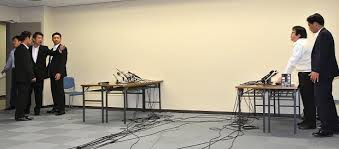
Last Monday, a fairly feisty political standoff took place within the Osaka City offices when the current Mayor and co-founder of the Reformation Party, Hashimoto Tōru, a figure who has featured on this blog in the past, got into a mud-slinging match (J) against the head of the “Association of City Residents who won’t allow special residency rights for Koreans” (or Zaitokukai for short), an even more odious figure by the name of Sakurai Makoto.  Much of what the two gathered to discuss was related to the topic of “hate speech”, an issue that has emerged within Japanese political and social circles as of late, driven in part by anti-Korean and anti-Chinese demonstrations by right wing groups in Tokyo and other major cities, but given a huge kick into the spotlight by the declaration by the UN Human Rights Council in July that Japan needed to introduce regulations banning discriminatory and racist rhetoric against members of minorities living in Japan (J).    

The Zaitokukai mainly focus their attention on schools and associations belonging to North Koreans (or Koreans who affiliate themselves with North Korea for historical reasons) residing in Japan, a situation that stems from the history of social conflict between Koreans transported to Japan during WWII to labour in Japanese industries, but who were unable to return to Korea after the war nor were granted Japanese citizenship, and Japan’s nationalist organisations who resented the presence of the Koreans as foreigners, cheap labour, and a reminder of Japan’s defeat.  According to the Zaitokukai, Koreans who have special permanent residency arrangements and who are granted economic and welfare benefits because of their ethnic heritage should have this status overturned and be treated as any other foreign resident in Japan with the same limit on rights and access to services.(J)

Hashimoto Tōru, who himself has admitted to his father’s affiliation with criminal gangs and members of the Burakumin caste in the past, has certainly come into contact with members of the Zainichi  (or Koreans resident in Japan) community throughout his life.  Whether this had any influence on his reaction to Sakurai’s questioning during last week’s meeting is purely speculative, but given Hashimoto’s comments during the short-lived encounter (scheduled for 30 minutes, the meeting didn’t last 8), he clearly didn’t appreciate Sakurai’s attempts to belittle him over Osaka City’s regulations related to hate speech.  Hashimoto certainly came into the room in a combative mood, and Sakurai didn’t disappoint, kicking off his comments with “These (hate-speech related comments) are what you said, aren’t they?”, using the more familiar anata proper noun for “you”, before immediately following it up with o-mae, an even less appropriate manner of address for what was supposed to be a formal meeting (video for their meeting can be found here).

It’s hard to see what the point of this meeting was, given that Sakurai just appeared to want to use it as an opportunity to big-note himself and perhaps advertise his book “The Age of Great Hatred of Koreans”. If you look at this footage before Hashimoto arrived (video here), Sakurai was doing his best to slag off the media who had assembled to report on the meeting (mainly Kyodo Press, the Mainichi Shimbun, and NHK), so clearly he wasn’t going to attempt to debate anything – his purpose was to try and embarrass the mayor. He didn’t succeed, although he did later claim that he “won” the meeting by causing Hashimoto to lose face.  Strangely enough, Hashimoto basically told Sakurai to go and make his complaints about hate speech to the federal government, or else stand for election. Either way, it wasn’t an edifying display by either leader.

The following day, Mayor Hashimoto made an even stranger comment, saying in a press conference that there was “a need to streamline the (special residency visa) system along the same lines as other foreigners”, and that “special treatment leads to discrimination”, which for all intents and purposes sounded like Hashimoto was endorsing what Sakurai was yelling the day before (J). It may be that Hashimoto, remembering that his own party were still represented at the federal level, decided that his party’s conservative credentials would be better served by drawing attention to the permanent residency system and its need for an overhaul.

For a mayor who has landed himself in hot water in the past for his comments regarding comfort women (J), this latest performance by Hashimoto (for that’s ultimately what it was) could have been an opportunity to demonstrate that at least on this front, he could be progressive in his attitude towards resident Koreans and the elimination of discriminatory language and actions against minorities. That didn’t happen, and instead Hashimoto appeared to weasel his way out of controversy by tacitly backing the demands of the Zaitokukai.  If anything did come of the meeting, it’s the plain fact that attempting to reason with extremists is a futile task as they are not open to changing their minds – they believe what they believe, and the rest be damned.  Then again, perhaps Hashimoto knew this from the very beginning and so wanted the public to get a look at what sort of organisation the Zaitokukai is.  If this was the case, then kudos to Mayor Hashimoto.

2 Comments

The militarised village

21/10/2014

3 Comments

 
PictureSource: blogs.yahoo.co.jp
This particular post takes as its inspiration a chapter from the book “Sengoku no Mura o Yuku” (戦国の村を行く, or “A journey through the villages of the era of the warring states”), a pivotal work by Fujiki Hisashi on the development of villages in the Kinki region during the late Muromachi, early Sengoku period as military institutions and how these villages managed to survive periods of turmoil resulting from the lack of a powerful central government. While some might groan “oh Christ, not another translation”, it should be noted that this blog doesn’t only take current events as its motivation, but any subject that I might wish to bring to a wider audience. What that audience then thinks of the post is up to them. 

What on earth was the “military strength of a village”?

The beginning of the fifteenth century was the era of the Muromachi Bakufu.  In autumn of the 6th year of Eikyō (1434), the people of the capital were in a state of distress, for once again rumour had reached them that the “monks of the mountain”, the warrior monks of Hieizan, had taken up the omikoshi (or ‘portable shrine’) of Hie shrine and were making their way towards the capital in protest.  Should they reach the capital, the wrath of the gods could be frightful indeed. (p.62)

Having gotten word of the monks’ progress, the Muromachi Bakufu was in a state of high tension. To halt the progress of the monks into the capital, the Bakufu ordered its senior commanders (the so-called “three Kanrei”, along with four prominent warrior families under its direction) to place themselves in the north of the city, where they would directly face off against the monks, along with the central districts of the city that housed the residence of the shōgun and the Imperial palace. At the same time, the Bakufu sent out word to the various landowners around the capital, and through them to the villages of the estates located in Fushimi, Yamashina, and Daigo, ordering them to assemble the villagers for action.  These events were referred to in two diaries, ① the Mansai Jūgō Nikki, and ② the Kanmon Nikki in the following manner.

① <山城の醍醐あて>便宜のところへ罷り出て、東口へ落ち行く山徒ら候わば、打ち留め、具足等をも剥ぎ取り候べし。(To Daigo in Yamashiro province) Make your way to a convenient location, and should monks from the mountain arrive at the eastern entrance, stop them there and take their equipment from them)

② <山城の伏見あて> 伏見の地下人、悉く罷り出て、山徒ら神輿を振り捨て、帰る路を防戦すべし。(To Fushimi in Yamashiro province) Rouse up the lower classes in Fushimi, force the mountain monks to abandon their shrine, and cut off the monks’ route of escape)

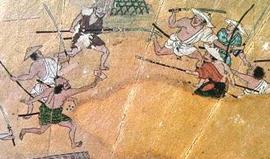
What the Bakufu was asking was for the villagers in the estates to be mobilised and for them to lie in wait for the monks’ approach.  Any of the monks who might fall behind following an attack by the Bakufu force were to be disarmed and have their belongings (meaning armour) stripped from them. The mention of the “convenient location” is particularly interesting.  Exactly how the villagers mobilised themselves and carried out their attack was purely up to them. Since they knew the territory better than anybody, all the Bakufu wanted them to do was to capture any defeated monks. (p.63)

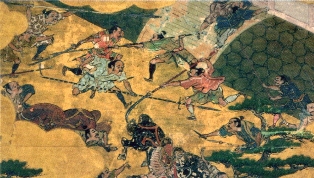
Speaking of capturing defeated monks, the Taiheiki, compiled a century earlier, was vivid in its description of the practice of attacking defeated warriors.  Those warriors who, exhausted and defeated, attempted to flee to the villages surrounding the battlefield would face the following dilemma;

案内者ノ野伏共、所々ノツマリツマリニ待受テ、打留ケル間、日々夜々ニ、討ル丶者、数ヲ知ズ。希有ニシテ命計ヲ助カル者ハ、馬、物具ヲ捨、衣裳ヲ剝取レテ。。。(The locals that know the area lie in wait in various places both day and night, and should they happen upon a defeated warrior, spare his life if he surrenders his horse and belongings)

It certainly appears as though the activities of these locals were virtually identical to the content of orders released by the Muromachi Bakufu to halt the progress of monks heading towards the capital. It appears as though originally, any warrior wearing strange or unfamiliar armour who attempted to sneak into a village would be disarmed and stripped by the villagers and then sent on his way.  This was the so-called provision for “the peace of the village”. In order to preserve the peace in the village and the surrounding region, the villagers themselves would act in defence of their interests. However they would not act if they were asked to do something that was beyond their ability to perform.  The Muromachi Bakufu, by requesting that villagers use “a convenient location” to attack defeated monks, well knew the tactics and the limits of the actions that they could ask villagers to undertake. (pp.63-64)

While much was made of the military abilities of villagers, villagers certainly were not sent into the front lines during a battle, but were mostly used in the rear, conducting mopping up operations and the like.  Rather than pointing to the skill (or otherwise) of villagers, what this tells us is that there was a very clearly delineated role for both soldiers and farmers in medieval society, a medieval version of the ‘division of samurai and peasant’ ideology that came to dominate later eras. (p.64)

So what happened at the Fushimi estate when they received the order from the Bakufu? The diary “Kanmon Nikki”, written by a landowner on the Fushimi estate, explained all in the following entry;

地下の輩、緩々と用意なきのあいだ、召集のため、即成院の早鐘を鳴らし、晩景に御香宮に集会し、着到を付く(略)已上、侍七人、下人五十人、(略)半具足の輩、一荘駈集る、

When the orders arrived from the Bakufu, the villagers on the estate did not immediately spring into action and took the news in their stride.  Hence the “samurai”, those younger men in the villages who had responsibility for leading others in battle, had to hurriedly gather together a force.  Firstly, the bells of Sokujōin, a temple located on the estate, were rung in earnest, signalling to the villagers to assemble.  In the evening at the shrine of Onkōnomiya, again located at the centre of the estate, the villagers gathered together wearing an assortment of light armour (or 半具足, Hangusoku). There the villagers discussed what tactics they would use, and the name of each participant (making a total of more than 300) was recorded in a ledger as having “arrived” or presented themselves for duty.(p.66)

The original version of the ‘arrival’ ledger was almost exactly the same as the contents described in the diary.  The original ‘seven’ samurai described at the beginning of the diary entry each had the epithet “child of” or “younger brother of” after their names.  Thus when the village was called into action, these young “seven samurai” bore responsibility for the welfare of the village, and together with other troops (下人, Genin, literally ‘lower people’) combined to make a force of 50.  These young men, as they were leaders of a military force, were thus referred to with a pseudo-honorific title of ‘lords of the fields’ (殿原若輩, Donobara Jyakuhai). (p.66)

The records of six villages in the estate also noted the number of participants from each village, thereby telling us that each village had a system in place for the organisation of a military force should it prove necessary.  The members of these forces were civilian soldiers, often referred to as “凡下, Bonge”, or “commoners”. This combination of “samurai”, “lower people”, and “commoners” was a form of medieval social strata (similar to the early modern social order of “warriors, farmers, manufacturers, and merchants”) with those designated as “samurai” the leaders of this village system of mobilisation.  Below them came the “lower people”, and then the “commoners”. (p.66)

From the ringing of the bells to the assembly of the villagers, such a rapid response was almost textbook.  It would have been impossible for so many villagers to gather together, armed and ready for action, without plenty of practice and training.  As proof of this, the records of the time note when each delegation from each village arrived, and the names of the participants. This was a military measure well known to warriors in camp, but less so concerning villagers.  Hence the villagers themselves obviously had great experience in the ways of war, and had responded accordingly. (pp.67-68)

A century later, Akechi Mitsuhide, the betrayer of Oda Nobunaga, would be defeated at the battle of Yamazaki by Toyotomi Hideyoshi. In the evening following the battle, and with his forces scattered, Mitsuhide would meet his fate at the hands of a ‘commoner uprising’ (土民の一揆) by the villagers of Ogurusu of the Fushimi estate. This was as described in the ‘Taikōki’(太閤記, or the Records of Hideyoshi), and was most certainly fact.  Just thinking about this right now, the reference in the diary to the ‘commoner uprising’ was terribly discriminatory towards the villagers themselves, yet Mitsuhide’s defeated warriors had been set upon by the said villagers. Otherwise Hideyoshi, as part of his strategy, had made allies of the villagers of Fushimi estate and that hunting down defeated warriors was an aspect of this. (p.68)


3 Comments

Seppuku as a form of revenge

12/10/2014

2 Comments

 
PictureSource: togetter.com
This will be the last in this series of posts, mainly because this I thought it high time I moved on to other subjects, and also because the process of translation requires more time than I can give to it.  The text of course comes from Shimizu Katsuyuki`s Kenka Ryōseibai no Tanjō.

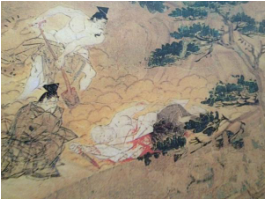
And so, in such a cruel society, what could people do who didn`t have close connections to the law courts to enable them to win cases, or who did not possess the strength to be able to defend their cause, if they had to clash with an enemy? For them, a means did exist that would allow them to have justice without having to cry themselves to sleep, the most extreme form of revenge that existed in medieval Japanese society. (p.43)

Article 43 of the provincial laws (known as the Jinkaishū, or 塵芥集) set down by Date Tanemune of Mutsu (the great-grandfather of the `one-eyed dragon` Date Masamune) in the 5th year of Tenbun (1536) featured the following regulation;

“一、自害の事、題目を申し置き死に候はゞ、遺言の敵、成敗を加ふべきなり” (Item, in relation to acts of suicide, should the reason for the act be written down and left for posterity, the perpetrator shall be summarily punished)

In other words, if the person who committed suicide left a note detailing the `daimoku, 題目` or reason  why they had committed suicide, the `perpetrator` (literally, the `enemy` described in the note) would later be punished by the Date family on behalf of the aggrieved (and deceased) plaintiff. To put it another way, in the lands controlled by the Date family during the Sengoku period, if one did not have the strength or influence to rid oneself of an enemy, if this same person later wrote down their grievances and committed suicide, the Date family would take it upon themselves to meet out justice on behalf of the deceased. Of course, although one could speak of `suicide`, there were many ways in which people might choose to off themselves, and so the Jinkaishū continued by saying that if the person concerned left no record of why they had done what they did, then the Date family would have nothing to do with them or their grievances.  There was also a subclause added that noted that in some cases it would be necessary to judge such wills `on their merits` (or Jigi, 時宜). (p.44)

Yet just by going by the main text, it is obvious that in principle, the Date family gave particular respect to the will and testament of people who committed suicide, and so one can conclude that the Date acted as a sort of substitute or `stand in` to meet out revenge on behalf of the deceased and in accordance with public law.

To we in the modern age such a proviso seems contrary to all common sense, hence we must ask why the Date paid such close attention to the needs of suicide victims? To understand this, we must backtrack a bit to the Muromachi period. (p.44)

In the sixth month of the 1st year of Kakitsu (1441), Ashikaga Yoshinori, the shōgun, was assassinated by the Shugo Daimyō Akamatsu Mitsusuke at Mitsusuke`s residence in Kyoto.  This was the so-called `Kakitsu Incident`. The Shugo Daimyō Ōuchi Mochiyo, out of sheer bad luck, happened to be in the same residence when the assassination was carried out, and so got caught up in the ensuing chaos and received life-threatening wounds.  Nevertheless, Ōuchi did manage to make it back to his own residence.  In the political chaos that engulfed Kyoto following such an unnatural death of the shōgun, a number of protests broke out as people learned of the `testament` of Ōuchi who lay at death`s door.  According to this testament, Ōuchi said “As my wounds grow worse, should I die, those of my retainers that are left must hurry to the residence of the Kanrei and there commit seppuku”. (p.44)

By this time, a rumour had been going around Kyoto that this act of treachery had been organised by the Kanrei, Hosokawa Mochiyuki in league with Mitsusuke. Although it was later proven that Ōuchi`s testament was in fact a fake, the fact that the people of Kyoto at the time were prepared to believe that Ōuchi`s retainers had rushed into the Kanrei`s residence in order to commit ritual suicide so as to express the indignation of their lord has considerable value.  As the Jinkaishū demonstrated, in the Muromachi period, to commit suicide was a means of expressing one`s anger and indignation at one`s enemy. For example, in the 1st month of the 4th year of Kakitsu (1444), a person by the name of Kitagawa Bō, who was apparently a retainer to the aristocrat Ōgimachi Sanjō family, committed seppuku out the front of the family library.  At the time, some believed that Kitagawa had `gone awry`, while others believed that Kitagawa had acted as he did out of some anger or dissatisfaction towards his lord.(p.45)

We of course will never know the real reason why Kitagawa did what he did, yet this does provide an interesting example of what the people of the Muromachi period thought about the act of suicide. If Kitagawa was indeed of sound mind when he chose to commit suicide out the front of his lord`s treasured library, then we must first imagine that this was an expression of anger or dissatisfaction in his lord.  In the Muromachi period, an act of suicide was clearly regarded as a powerful form of expression of rebuke or dissatisfaction towards one`s enemy. As the Jinkaishū also demonstrated, the passionate mentality of the people of the medieval period can be seen in the background of those acts labelled as suicide.(p.45)

2 Comments

Traditions, precedents, and the cruel logic of `Jiriki Kyusai`

8/10/2014

1 Comment

 
PictureSource:blog.webpage3.yahoo.co.jp
Thus in Japanese society of the medieval period, there were certainly `public laws`, such as those for warriors, aristocrats, and religious institutions, that were codified and broadly applied. On the other hand, there was another dimension to the law, such as laws for villages, regional settlements, or groups of tradesmen, that might otherwise be described as  `precedents`, `prior examples`, or `common knowledge` and which also existed across society.  It was not unusual for these two branches of laws to co-exist with one another despite their contradictory, complicated content, and when people wished to sue one another, they would chose which laws that suited their particular circumstances and which they claimed justified their position. The usage of the term `as according to` (と号する) became a mainstay for people of the medieval period trying to subjectively state their claims.(p.40)

For our modern `rule of law` society, this state of affairs appears similar to anarchy,  yet these multiple legal precedents had a much greater weighting in society at the time than the more formally established laws – indeed this was significant characteristic of the age.  That it to say, in medieval society the `law` held varying degrees of value and could be manipulated to either exacerbate or relieve a situation. The more formally codified public laws were no more than one part of the `varying degrees of value` given to `the law`. (p.40)

The ethos that justified `katakiuchi` can be thought of as another of the legal mores of the age. Formally codified public laws were created by the people of society at the time, and thus legal precedents and traditions (such as katakiuchi) could have an enormous impact on society.  As we saw earlier, one of the largest mistakes made by legal histories of katakiuchi in the post-war period (which explained that such practices were illegal) is that they tended to overlook the significance of precedents and traditions. Although the publically codified laws of the time might have banned katakiuchi,   this does not prove that katakiuchi was considered to be an illegal act by medieval society.(p.40)

For example, the scholar Katsumata Shizuo analysed a social phenomenon similar to katakiuchi known as `megatakiuchi` (女敵討, or `killing a marital interloper`). `Megataki` (which could also be written as 妻敵) referred to a man (other than oneself) who slept with one`s wife, hence megatakiuchi  was the practice whereby a husband would kill the other man out of revenge. According to Katsumata`s research, section one of Article 34 of the Goseibai Shikimoku from the Kamakura period bans the practice of megatakiuchi. Yet in medieval society at the time the practice of megatakiuchi was widespread, and there did not appear to be any awareness among those engaging in megatakiuchi that what they were doing was illegal.  Rather the stance of the Kamakura Bakufu, by trying to make such a practice illegal, was itself regarded as `abnormal`. Hence Article 34 of the Goseibai Shikimoku really did not have any meaning, at least not for Kamakura era society. As proof of this, the practice of megatakiuchi actually escalated throughout the Muromachi period, and in the regional laws of Sengoku era daimyō was one of the practices sanctioned under the law and was codified. One could call it a typical example of the more formal public `law` and common `law` combining their strengths.(p.41)

From the 1980s onward in medieval Japanese research circles, the self-governing practices of the common folk in villages and towns became a focal point of study.  The existence of group acts of vengeance by villages and towns became widely known. As the results of studies by Fujiki Hisashi demonstrated, in the territorial disputes carried out between villages known as sōron there were various legal precedents for both issuing challenges and conceding defeat. Thus despite the violence of the times society still recognised the legitimacy of certain acts.  Although medieval Japanese history research has only recently shed light on these phenomena, what is certain is that medieval Japanese society itself did sanction the practice of revenge.(p.41)

To try to recover one`s honour or goods without recourse to public law is known by the historical legal term of `jiriki kyūsai` (or `self-preservation`). Medieval Japanese society did not necessarily regard such practices with a favourable eye yet it did tacitly acknowledged them. As a poem of the Nambokuchō period put it… `the dead before the entrance to hell, if they do not complain, shall not be heard`. In other words, even if a dead body was rolled up to the gates of the afterlife, if no complaint was raised about the death, then according to the public law this would not result in a criminal investigation. Just as the poem said, justice at the time was founded on the principle of `laissez faire`, and if no case was raised by either plaintiff, then public law had no authority to either launch its own investigation or to arrest any suspects.(p.42)

For the aggrieved, this meant that they could either rely on the public law or take the law into their own hands – the choice was entirely up to them. Of course, if one were to choose to practice `jiriki kyūsai`, and if the other side did not object, then there was nothing that the public law could do to intervene.  This is to say, rather than describing the practice of revenge as being `sanctioned`, it would be more correct to say that it was `permitted`. While revenge may have officially been banned in medieval Japanese society according to public law, for society at large the practice continued both far and wide and was tolerated, which in itself was a dichotomy.   From the Muromachi through to the Sengoku era, the public law was superseded by social contracts and practices, so much so that these practices soon became public law themselves. The fact that the legal officials of the Ashikaga Bakufu began to divert from the content of the Goseibai Shikimoku and gave their approval of katakiuchi is proof of this trend.(p.42)

1 Comment

    Author

    This is a blog maintained by Greg Pampling in order to complement his webpage, Pre-Modern Japanese Resources.  All posts are attributable to Mr Pampling alone, and reflect his personal opinion on various aspects of Japanese history and politics (among other things).

    弊ブログをご覧になって頂きまして誠に有難うございます。グレッグ・パンプリングと申します。このブログに記載されている記事は全て我の個人的な意見であり、日本の歴史、又は政治状態、色々な話題について触れています。

    Categories

    All
    Disasters 災害
    Edo Period 江戸時代
    Japan Australia Relations 日豪関係
    Japanese Politics 日本の政治
    Japan Korea Relations 日韓関係
    Kamakura Period 鎌倉時代
    Meiji Period 明治時代
    Miscellaneous 雑学
    Muromachi Period 室町時代
    Regional Politics 地域の政治
    Regional Politics 地域の政治
    Second World War 太平洋戦争
    Sengoku Period 戦国時代

    Archives

    June 2024
    May 2024
    November 2023
    January 2023
    January 2022
    December 2021
    August 2021
    October 2020
    September 2020
    July 2020
    May 2020
    April 2020
    March 2020
    December 2019
    July 2019
    February 2019
    December 2018
    November 2018
    September 2018
    August 2018
    July 2018
    June 2018
    May 2018
    April 2018
    March 2018
    February 2018
    January 2018
    December 2017
    November 2017
    October 2017
    September 2017
    July 2017
    June 2017
    March 2017
    January 2017
    August 2016
    July 2016
    June 2016
    May 2016
    April 2016
    March 2016
    February 2016
    January 2016
    December 2015
    November 2015
    October 2015
    September 2015
    August 2015
    July 2015
    June 2015
    May 2015
    April 2015
    March 2015
    February 2015
    January 2015
    December 2014
    November 2014
    October 2014
    September 2014
    August 2014
    July 2014
    June 2014
    May 2014
    April 2014
    March 2014
    February 2014
    January 2014
    December 2013
    November 2013
    October 2013
    September 2013
    August 2013
    July 2013
    June 2013
    May 2013
    April 2013
    March 2013
    February 2013
    January 2013
    December 2012
    November 2012
    October 2012
    September 2012
    August 2012
    July 2012
    June 2012
    May 2012

    RSS Feed

© 2025 www.farbeyondthemiyako.com. All Rights Reserved.